

Pick ClickUp if you want the most capability per dollar and have someone willing to configure it. Pick monday.com if adoption matters more than features and your team needs a board that explains itself. At ten seats the headline prices are nearly identical. The difference shows up in automation caps and seat math.
Everything below was checked against the vendors’ own pricing pages and help documentation in late July 2026. Prices move, so treat the linked pages as the source of truth and this article as the map of where the traps are.
The short version, in a table
| Point of comparison | monday.com (Work Management) | ClickUp |
|---|---|---|
| Cheapest paid plan | Basic, $9 per seat/month billed annually | Unlimited, $7 per user/month billed yearly |
| Plan most teams actually land on | Standard $12, or Pro $19 if you need time tracking | Business $12 |
| How seats are sold | Buckets: minimum 3 seats, then multiples of 5 | Per individual user |
| Timeline and Gantt views | Standard and above | Unlimited and above |
| Native time tracking | Pro and above | Unlimited and above |
| Automation actions per month | 250 on Standard, 25,000 on Pro | 1,000 on Unlimited, 5,000 on Business |
| Cross-project dashboards | 5 connected boards on Standard, 20 on Pro, 50 on Enterprise | Unlimited dashboards from Business |
| Free tier ceiling | 2 seats, 3 boards, 3 docs | Unlimited members, 60MB storage, 100 automation actions/month |
| AI cost model | Bundled credits: 1,000/2,000/3,000 per month by tier | Separate add-on: Brain $9/user, Everything AI $28/user |
What a 12-person team actually pays
Headline per-seat prices are not what lands on the invoice, and monday.com is where that bites first. Its support documentation describes bucket pricing: plans start at a minimum of three seats and then ascend in multiples of five. A team of twelve cannot buy twelve seats. You buy fifteen.
So on Standard, twelve people cost 15 x $12 = $180 per month billed annually, or $2,160 a year. Your effective rate is $15 per working human, not $12. Move to Pro because you want time tracking and dependency columns, and it becomes 15 x $19 = $285 per month, $3,420 a year, or $23.75 per actual person. Nobody quotes that number in a demo.
ClickUp bills per user, so twelve people on Business is 12 x $12 = $144 per month, $1,728 a year. On Unlimited it is $84 per month. There is no rounding up.
The interesting case is a team of exactly ten. monday.com Standard and ClickUp Business both come to $120 per month. Same money, very different contents. ClickUp Business includes 5,000 automation actions a month; monday.com Standard includes 250. ClickUp Business includes unlimited dashboards; monday.com Standard dashboards can connect five boards. ClickUp has had native time tracking since the $7 tier; on monday.com it arrives at $19. If you are comparing those two line items, ClickUp is carrying more weight for the same price.
Then there is AI, and the two vendors have gone in opposite directions. ClickUp sells it as a per-user add-on stacked on top of your plan: Brain AI at $9 per user per month, or Everything AI at $28. Adding Brain to twelve Business seats takes you from $144 to $252 a month. Everything AI takes you past $480. monday.com instead bundles a monthly AI credit allowance into each plan: 1,000 credits on Basic, 2,000 on Standard, 3,000 on Pro. Note that the pricing page currently shows promotional strike-through totals on Standard and Pro (at ten seats, $120 against a crossed-out $140, and $190 against $220). A promotional discount is not a permanent price, so budget from the undiscounted figure. For the full tier-by-tier ClickUp picture, see our ClickUp pricing breakdown for 2026.
One more billing detail: monday.com’s yearly commitment is 18% cheaper than paying monthly, and ClickUp’s pricing page advertises savings of up to 30% for yearly. Every figure in this article is the annual rate. Monthly billing costs more on both platforms.
Where monday.com is genuinely the better buy
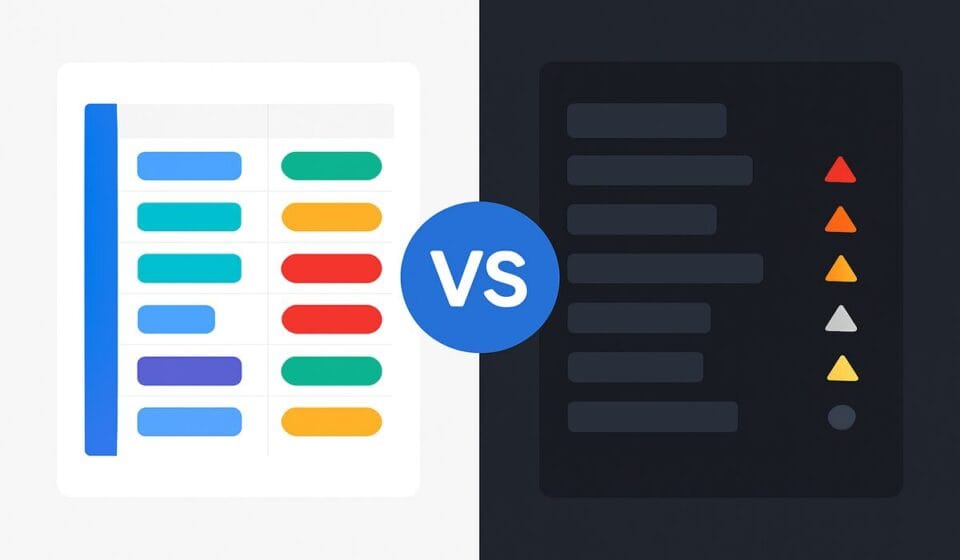
The board-and-column model is the whole argument. A monday.com board looks like a spreadsheet with colour-coded status columns, and people who have never used project software can read one without training. That is not a small thing when you are rolling out to a marketing department or a client services team that did not ask for new software.
Guest access, available from Standard, is the other strong case. External collaborators get invited to specific boards and see nothing else in your account. Agencies running client-visible boards get a lot of value out of that boundary, and it is cleaner than the equivalent setup in most competitors.
monday.com also sells separate products on the same underlying platform: Work Management, CRM, dev, and service. You can bundle them, put each on a different plan with a different seat count, and keep them on one billing cycle. If your operations team and your sales team both need something and you do not want two vendors, that structure is worth real money.
Finally, dashboards look presentable to an executive audience without much work. The widgets are opinionated in a way that produces a chart someone will actually put in a board deck.
Where ClickUp is genuinely the better buy
Capability per dollar at the bottom of the range is not close. ClickUp Unlimited at $7 includes unlimited Gantt charts, native time tracking, unlimited custom fields, unlimited storage, unlimited integrations, and goals. To assemble that same list on monday.com you are at Pro, $19 a seat, before seat rounding.
Automation headroom is the second argument. Business gives you 5,000 actions a month and turns on conditions, webhooks, and automation integrations. If your workflow involves anything like “when status changes, move the task, notify the channel, and update the parent,” you are consuming three actions per trigger, and 250 a month evaporates.
The hierarchy is deeper too. Space, Folder, List, Task, Subtask gives you somewhere sensible to put a large programme of work, and every list can carry multiple views. Teams migrating off a tool with a flat structure usually feel that immediately. Sprint management is available on the free tier, which makes ClickUp an easy pilot for a small engineering group. Our comparison of ClickUp against Asana covers how that hierarchy holds up against a more opinionated competitor, and ClickUp against Microsoft Project covers the scheduling-heavy end of the spectrum.
monday.com’s real downsides
Seat buckets are the headline problem. Eleven people, fourteen people, sixteen people: all of them pay for seats they are not using. It also makes downgrading awkward, because the seat options below your current usage are greyed out at checkout until you deactivate users first.
The 250-action monthly automation budget on Standard is tighter than it sounds. That is roughly eight actions a day across your entire account. One moderately busy board with a status-change notification will exhaust it, and the only remedy is Pro at $19 a seat.
Dashboard reach is the quiet constraint. monday.com’s dashboard documentation puts connected boards at 1 on Free, 5 on Standard, 20 on Pro, and 50 on Enterprise, with a hard ceiling of 20,000 total items across everything connected to a single dashboard and a maximum of 30 widgets. If your reporting model is “one board per client” and you have thirty clients, cross-client reporting is a Pro or Enterprise feature whether you budgeted for it or not.
The free plan is a trial in everything but name: two seats, three boards, three docs. It is not a workspace you can run a small business on, which is worth knowing before you plan a slow-burn rollout. If free is a hard requirement, our roundup of free project management tools worth using is a better starting point.
ClickUp’s real downsides
The free tier gives you 60MB of storage. That is a demo allowance. Two design files and a video recording and you are done. Unlimited members on a plan you cannot store anything in is a strange offer, and teams that pilot on Free often draw the wrong conclusion about the product.
Configuration debt is the honest cost of the flexibility. ClickApps toggle per Space, views are per list, custom fields multiply, and a workspace that nobody curated turns into a place where two people file the same task in two different structures. Somebody on your team has to own that. If nobody does, ClickUp gets worse over the first six months rather than better.
Automation limits deserve attention beyond the monthly totals. ClickUp’s documentation caps a single automation at one trigger, fifteen conditions, and six actions, so genuinely branching logic has to be split across several automations, each consuming its own actions. Conditions are only available from Business up. And when you exceed the monthly action limit, your workspace’s automations are paused for the rest of the month, which is a hard stop rather than a slowdown. Compounding that, automation usage history is retained for one day on Free, Unlimited, and Business, so diagnosing what burned your budget last Tuesday is difficult.
There is also a documentation inconsistency worth knowing about. ClickUp’s public pricing page currently shows four tiers, while the help centre still documents a Business Plus plan with its own 25,000-action allowance. If you are reading a support article to check whether a feature is included, confirm the tier names against the pricing page.
A decision process you can finish this week
- Count your actual headcount, then round it up to 3, 5, 10, 15, or 20 to get monday.com’s real seat count. Multiply by the plan rate you need, not the entry rate.
- Write down the three automations you know you want. Multiply by how often each fires per month, then multiply by the number of actions in each. Compare against 250, 5,000, or whatever tier you were planning to buy.
- List your reporting requirement in board terms. If one dashboard has to span more than five boards, monday.com Standard is off the table.
- Check who will own configuration. If the answer is nobody, weight the decision toward monday.com regardless of the price difference.
- Run a two-week pilot on the real work, not a sample project. monday.com’s billing FAQ allows a partial refund if you cancel a yearly subscription within 30 days of purchase, and ClickUp publishes a 30-day satisfaction guarantee for first-time paid customers.
Frequently asked questions
Is ClickUp cheaper than monday.com?
At list price, yes. ClickUp Unlimited is $7 per user per month billed yearly against monday.com Basic at $9 per seat. The gap widens because monday sells seats in buckets, so a team of twelve pays for fifteen. Compare your own headcount against both pricing pages before assuming the gap holds.
Does monday.com really make you buy seats you don’t need?
Effectively, yes. monday.com’s documentation describes bucket pricing: plans start at three seats and then move in multiples of five. Eleven people means buying fifteen seats. The unused seats are not wasted if you plan to hire, but they are a real line item on the invoice today.
Which one handles automations better?
ClickUp, on volume. Its Business plan allows 5,000 automation actions a month; monday.com Standard allows 250 and Pro allows 25,000. ClickUp also pauses automations once you exceed the monthly limit, so watch usage. monday’s higher Pro ceiling matters only if you are already paying $19 a seat.
Can I run agile sprints in both?
Both support sprints. ClickUp includes sprint management on its free tier, with sprint points and reporting arriving on Business. monday.com handles sprints through boards and its separately priced dev product. If sprint reporting is your main use case, test the reporting views first, and see our monday.com sprint setup guide.
Which is easier for a non-technical team to adopt?
monday.com, usually. Its board-and-column model reads like a spreadsheet most people already understand, so the first week goes smoothly. ClickUp gives you far more surface area, but someone has to decide which views, custom fields, and ClickApps each space actually needs, and that decision cannot be skipped.
Sources for the numbers above
All figures were read directly from vendor-owned pages: monday.com’s pricing page for Work Management seat rates and plan gating, ClickUp’s pricing page for plan and AI add-on rates, ClickUp’s automation limits documentation for per-plan action caps, and monday.com’s dashboard documentation for connected-board limits.
Sponsored