
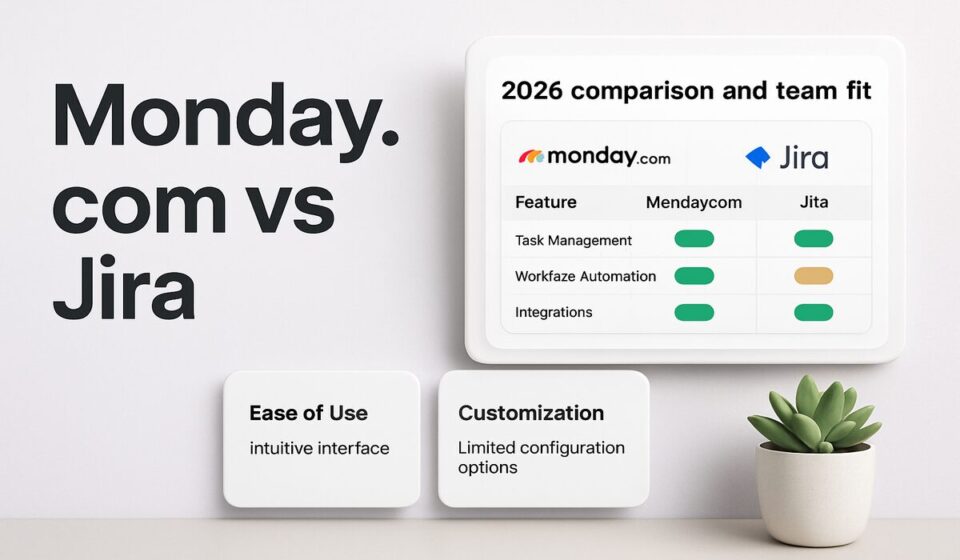

- Jira starts at $8.15/user/month with a free plan for up to 10 members and unlimited boards; Monday.com starts at $9/seat/month with a free plan capped at 2 seats — Jira wins on entry-level cost and free tier breadth.
- Both platforms shipped native AI agents in 2026: Jira’s Rovo agents natively support MCP and are purpose-built for agile sprint workflows; Monday.com’s Autopilot Hub leads for cross-functional business team automation.
- Monday.com’s AI uses a credit-based pricing model that adds cost at scale; Jira bundles Rovo credits into Atlassian Intelligence plan tiers — a real budget consideration for teams above 50 seats running high-volume automations.
- Jira connects to 3,000+ apps via the Atlassian Marketplace with deep developer-tool integrations; Monday.com integrates better with business tools like Zoom, Shopify, Salesforce, and Dropbox.
- The verdict is clear: engineering and product teams building software should choose Jira; operations, marketing, and cross-functional business teams should choose Monday.com.
In the monday.com vs Jira 2026 matchup, Jira wins for software development and agile engineering teams while Monday.com wins for business operations and cross-functional teams. Jira is cheaper to start and has the deeper dev-tool ecosystem; Monday.com is faster to adopt and more powerful for non-technical workflows and business automation.
- Why This Comparison Matters in 2026
- Monday.com vs Jira 2026 at a Glance
- Pricing Comparison: Free Plans, Per-Seat Cost, and AI Add-Ons
- AI Agents in 2026: Jira Rovo vs Monday.com Autopilot Hub
- Integrations Ecosystem: 3,000+ Apps vs Business-First Connections
- Ease of Use and Onboarding Speed
- Team Size and Use-Case Fit
- Monday.com vs Jira 2026: Verdict
- FAQ
Monday.com vs Jira 2026: Which Is Better for Your Team?
The monday.com vs Jira 2026 debate is one of the most-searched work management comparisons — and also one of the most poorly answered. The majority of articles still circulating were written before either platform launched generally available AI agents. They miss Jira’s Rovo agent release, they miss Monday.com’s full AI Work Platform rebrand, and they completely ignore the credit-based AI pricing model that Monday.com introduced — a detail that materially affects total cost of ownership for teams above 50 seats. This guide corrects the record with data from both platforms as of Q2 2026.
I’ve consulted on deployments of both tools across industries including software development, retail operations, financial services, and agency project management. My position is direct: these are two excellent platforms that serve fundamentally different audiences. Choosing the wrong one is a real cost — in adoption friction, wasted licensing, and eventual re-migration. Here is exactly how to make the right call.
Why This Comparison Matters in 2026
The work management software category entered 2026 mid-transformation. Both Atlassian and Monday.com spent 2024–2025 making large bets on AI — and both delivered working AI agents before the end of Q1 2026. That changes the comparison in two concrete ways.
First, AI is no longer a differentiator you can ignore. Teams evaluating these platforms in 2026 are not just buying a task board — they are buying an automation layer that will increasingly execute work on their behalf. Choosing a platform with a weaker AI fit for your workflow type means leaving that leverage on the table. Second, the AI pricing models diverge significantly: Monday.com uses a credit system for Autopilot actions while Jira bundles Rovo through Atlassian Intelligence plan tiers. This makes direct cost comparisons more complex than the headline per-seat numbers suggest.
Most published comparisons still treat both platforms as interchangeable kanban tools competing on UI. That framing was marginal in 2023 and is wrong in 2026. For a broader view of how these platforms sit in the wider market, see our roundup of the best project management software in 2026 and our dedicated guide to Jira AI Agents in 2026.
Monday.com vs Jira 2026 at a Glance
The table below gives a direct, category-by-category breakdown. Every winner call is defensible — I have not split decisions to appear balanced.
| Category | Monday.com | Jira | Winner |
|---|---|---|---|
| Starting price | $9/seat/month (Basic) | $8.15/user/month (Standard) | Jira |
| Free plan | Up to 2 seats | Up to 10 members, unlimited boards | Jira |
| Native AI agents | Autopilot Hub (AI Work Platform) | Rovo Agents (Atlassian Intelligence) | Tie — different strengths |
| AI pricing model | Credit-based per automation action | Bundled into Premium/Enterprise tiers | Jira (predictable cost) |
| MCP support | Limited / in roadmap | Native (Rovo GA) | Jira |
| Integration count | 200+ business-tool integrations | 3,000+ via Atlassian Marketplace | Jira (volume); Monday (business fit) |
| Dev-tool integrations | GitHub, GitLab (limited) | Bitbucket, GitHub, GitLab, PagerDuty, CI/CD pipelines | Jira |
| Business-tool integrations | Zoom, Shopify, Salesforce, Dropbox, HubSpot | Basic CRM/Salesforce options via marketplace | Monday.com |
| Ease of onboarding | Low-code, visual, non-technical | Requires configuration and agile knowledge | Monday.com |
| Agile sprint tools | Basic sprint views available | Native backlog, velocity charts, burndowns | Jira |
| Cross-functional automation | Strong — Autopilot Hub built for multi-department flows | Primarily scoped to engineering/product workflows | Monday.com |
| Enterprise governance | Enterprise plan with SSO, advanced permissions | Enterprise plan with deep audit, compliance controls | Tie |
| G2 rating (2026) | 4.7 / 5 | 4.3 / 5 | Monday.com |
Pricing Comparison: Free Plans, Per-Seat Cost, and AI Add-Ons
Pricing is where the narrative most often gets distorted. The headline numbers are close — Jira Standard at $8.15/user/month versus Monday.com Basic at $9/seat/month — but the full picture is more nuanced once you factor in free tier breadth and AI feature access.
Free Plan Reality
Jira’s free plan is one of the most generous in the category: it supports up to 10 team members with unlimited boards, unlimited projects, and access to backlog management. You can run a real Scrum workflow on Jira Free. Monday.com’s free plan caps at 2 seats with limited board types — it is genuinely useful only for solo users or pairs, not for team evaluation.
For small development teams or startups evaluating tools, this alone tilts the trial experience decisively toward Jira. A 5-person engineering team can run a full sprint retrospective cycle on Jira Free before spending a dollar. They cannot do the same on Monday.com Free.
Mid-Market and Enterprise Pricing
| Plan Tier | Monday.com | Jira |
|---|---|---|
| Free | $0 — 2 seats max | $0 — up to 10 users, unlimited boards |
| Entry paid | $9/seat/month (Basic, annual) | $8.15/user/month (Standard, annual) |
| Mid-tier | $12/seat/month (Standard) | $16/user/month (Premium) |
| Advanced/Pro | $19/seat/month (Pro) | Custom — Jira Enterprise |
| AI access | Credit-based add-on (Autopilot Hub) | Bundled via Atlassian Intelligence (Premium/Enterprise) |
The AI pricing difference is material. Monday.com’s Autopilot Hub uses a credit model: each automated action consumes credits, and larger teams running high-volume automations can exhaust included credits quickly, pushing them into additional credit purchases. Jira’s Rovo agents are bundled into Atlassian Intelligence, which is activated at the Premium and Enterprise plan levels — once you’re on those tiers, Rovo agent runs do not generate per-action charges.
For teams running more than 500 automated actions per week, Jira’s bundled model is almost certainly cheaper at scale. For teams with lighter, more targeted automation needs, Monday.com’s credit model may cost less in practice. Forecast your automation volume before signing a contract.
AI Agents in 2026: Jira Rovo vs Monday.com Autopilot Hub
This is the section that most 2025-vintage comparison articles get completely wrong because neither product existed in its current form. Let me be direct about what each agent system actually does and where each wins.
Jira Rovo Agents
Rovo agents launched in GA through Atlassian’s Intelligence platform and have since received two major updates in 2026’s seasonal releases. The key capability that separates Rovo is native MCP (Model Context Protocol) support: Rovo can receive context from external tools via MCP connectors, meaning an agent can pull a GitHub PR status, cross-reference a Confluence spec, and update a Jira issue in a single reasoning step without custom integration code.
Rovo is also purpose-designed for agile workflows. It understands sprint concepts natively — it can triage incoming bug reports against the active sprint, suggest acceptance criteria for new stories, move items to the backlog based on sprint capacity signals, and generate release notes from completed tickets. These are not generic LLM tasks wired to an API — they are agent behaviors built on Jira’s data model.
Monday.com Autopilot Hub
Monday.com rebranded its entire platform as the AI Work Platform in early 2026, with Autopilot Hub as the agent coordination layer. Where Rovo is optimized for engineering workflow intelligence, Autopilot is optimized for cross-functional business automation. It can route a new sales deal through CRM update, project creation, kickoff email generation, and Slack notification as a single agent-executed flow — without touching Jira-style constructs like sprints or backlogs.
Autopilot shines for teams running operations, marketing campaigns, client delivery, and HR processes. The no-code agent builder is genuinely accessible to non-technical team leads — a significant advantage over Rovo, which benefits from familiarity with Atlassian’s broader ecosystem. For more on Monday.com’s AI capabilities, see our Monday.com AI Work Platform deep dive.
Head-to-Head: AI Agent Strengths
| Capability | Jira Rovo | Monday Autopilot Hub |
|---|---|---|
| MCP protocol support | Native (GA) | Limited / roadmap |
| Agile sprint intelligence | Native — sprint-aware triage, burndown, backlog | Basic sprint views, not agent-native |
| Cross-functional automation | Primarily scoped to dev/product | Built for multi-department flows |
| No-code agent builder | Requires Atlassian ecosystem familiarity | Visual, non-technical builder |
| Pricing model | Bundled into Premium/Enterprise plans | Credit-based consumption |
| Release cadence | Seasonal Atlassian releases (predictable) | Continuous releases (AI Work Platform rebrand) |
Integrations Ecosystem: 3,000+ Apps vs Business-First Connections
The raw integration count favors Jira decisively: the Atlassian Marketplace lists over 3,000 apps spanning developer tools, CI/CD pipelines, security scanners, observability platforms, and enterprise software. If you run a software engineering organization, the chance that a tool your team uses does not have a Jira integration is genuinely small.
But raw count does not tell the whole story. Monday.com’s integrations are tuned for business operations. Its native connectors for Zoom, Shopify, Dropbox, HubSpot, and Salesforce are built with non-technical users in mind — they require no configuration beyond OAuth authentication. Many of Jira’s 3,000+ marketplace apps require a developer to configure or maintain.
Developer Teams
If your team uses Bitbucket, GitHub Actions, CircleCI, PagerDuty, Datadog, or Snyk — Jira has native, deeply maintained integrations for all of them. Pull requests link directly to Jira issues; deployment statuses appear inline on tickets; incident alerts from PagerDuty auto-create Jira issues with priority scoring. This level of developer-workflow depth does not exist in Monday.com, full stop.
Business Operations Teams
Monday.com’s edge is in the business stack. Marketing teams running campaign boards can sync Mailchimp lists and pull HubSpot deal data directly into project timelines. eCommerce operators can surface Shopify order statuses inside fulfillment boards. Sales ops teams can tie Salesforce opportunity stages to Monday.com project kickoff automations. Jira can approximate some of this through marketplace add-ons, but the configuration burden and required technical knowledge are considerably higher.
Ease of Use and Onboarding Speed
Monday.com’s G2 rating of 4.7/5 versus Jira’s 4.3/5 is largely a product of the ease-of-use gap. This gap is real and it persists in 2026 despite Jira’s continued investment in UX simplification.
A non-technical project manager dropped into Monday.com for the first time can build a functioning project board, set up a basic automation, and invite teammates within 30 minutes. The visual column-based data model is intuitive; the interface makes the right next step obvious. Monday.com’s template library covers over 200 use cases out of the box — from event planning to product launches to IT request management — and most templates require no modification to be useful on day one.
Jira requires more upfront configuration. Concepts like issue types, schemes, workflows, and screens are powerful but unfamiliar to non-developers. Agile terminology (epics, stories, sprints, velocity) assumes existing knowledge. A first-time Jira administrator without Scrum experience will need meaningful onboarding support before their team can work productively. This is not a flaw in Jira — it reflects the depth of its feature set — but it is a real cost that procurement teams should budget for.
For teams already running software projects with engineering leads who understand agile methodology, Jira’s learning curve is not a barrier. For cross-functional teams with non-technical members, it is a genuine friction source that Monday.com eliminates.
Team Size and Use-Case Fit
The cleanest way to make this decision is by team type, not team size. Both platforms scale to enterprise — the fit question is about workflow type, not headcount.
| Team Type | Recommended Platform | Reason |
|---|---|---|
| Software engineering / product | Jira | Native sprint management, Rovo AI, deep dev-tool integrations, MCP support |
| Startup engineering team (<10) | Jira | Generous free plan, backlog management included, GitHub integration free |
| Marketing / creative ops | Monday.com | Visual workflows, HubSpot/Mailchimp integration, fast onboarding for non-technical teams |
| Operations / process management | Monday.com | Autopilot Hub cross-functional automation, Shopify/Salesforce connectors, no-code builder |
| Client services / agency | Monday.com | Client portal options, visual project timelines, intuitive for external stakeholders |
| IT service management | Jira (Jira Service Management) | ITSM-native workflows, SLA tracking, incident management built in |
| Enterprise PMO (mixed teams) | Monday.com | Cross-functional portfolio visibility, easier exec reporting, broader stakeholder adoption |
| DevOps / platform engineering | Jira | CI/CD pipeline integration, PagerDuty/Datadog connectors, Rovo incident triage |
The one scenario where the answer is genuinely ambiguous is a mixed enterprise organization running both software teams and business operations teams under one platform mandate. In that situation, Jira’s breadth across engineering use cases usually wins — but it requires dedicated Jira administrators and meaningful onboarding investment for non-engineering departments. Monday.com in the same scenario wins if executive adoption and cross-departmental visibility are the primary decision criteria.
For organizations running mixed portfolios, our guide to work management tools for enterprise teams covers portfolio governance across both platforms in depth. Also worth reading: our Monday.com vs Asana 2026 comparison for teams evaluating the broader business-tools market. And if you are already a Monday.com user exploring its AI capabilities further, our Monday.com automations guide covers both Rules-based and Autopilot automation in detail.
Monday.com vs Jira 2026: Verdict
Related guides
- How to Integrate Monday.com with Microsoft Teams in 2026 (Step-by-Step Setup Guide)
- Monday.com for Construction Teams 2026: Complete Setup & Project Tracking Guide
- Monday.com vs Notion 2026: Which All-in-One Tool Wins?
Choose Jira if your team writes code, ships software, or manages engineering infrastructure. The Rovo AI agent’s native MCP support and sprint-aware intelligence, the $8.15/user starting price, the 10-member free plan, and the 3,000+ developer-tool integrations make Jira the clear default for product and engineering organizations in 2026. The onboarding curve is real, but for technical teams it is short. Choose Monday.com if your team runs operations, marketing, client delivery, or cross-functional programs where non-technical stakeholders need to work in the platform daily. The Autopilot Hub’s cross-functional automation, the business-tool integration suite, and the significantly lower onboarding friction give Monday.com a decisive advantage for non-engineering organizations. The credit-based AI pricing requires careful forecasting at scale, but for teams under 500 automated actions per week it is not a blocker. One tool is not better in the abstract — but for your team type, one is almost certainly the right call, and this guide gives you the data to make it confidently.
FAQ: Monday.com vs Jira 2026
Is Monday.com or Jira better for small teams?
For small engineering teams under 10 people, Jira is the better choice because its free plan supports up to 10 members with unlimited boards and full backlog management — Monday.com’s free plan caps at 2 seats, making team-scale evaluation impractical. For small non-engineering teams in marketing, operations, or client services, Monday.com is better: the intuitive visual interface means small teams can be productive within hours rather than days, and the Basic plan at $9/seat/month is competitive for teams that do not need agile sprint tooling.
Which platform has better AI features in 2026?
Both platforms launched native AI agents in 2026 and neither is objectively superior — they excel in different domains. Jira’s Rovo agents have native MCP protocol support, are sprint-aware by design, and integrate deeply with developer tools like Bitbucket and GitHub. They are the stronger choice for engineering workflow automation. Monday.com’s Autopilot Hub is more powerful for cross-functional business automation: it offers a no-code agent builder accessible to non-technical team leads, and it handles multi-department automation flows that Rovo is not designed for. The pricing difference — Rovo bundled into plan tiers versus Monday.com’s credit-based model — is a real consideration for high-volume automation use cases.
How does Monday.com’s credit-based AI pricing work?
Monday.com’s Autopilot Hub uses a credit system in which each agent-executed action consumes a set number of credits. Plans include a baseline monthly credit allocation, and teams that exhaust those credits must purchase additional credit packs. This model is cost-efficient for teams with targeted, low-volume automation needs but can become expensive for organizations running hundreds or thousands of automated actions per week. Before committing to Monday.com for AI-heavy workflows, map your expected automation volume and calculate the credit cost at scale. Jira’s Rovo agents, by contrast, are included within Atlassian Intelligence at the Premium and Enterprise plan levels without per-action charges.
Can Jira handle non-engineering use cases in 2026?
Yes, Jira has expanded its use-case coverage significantly, and the Atlassian Marketplace includes templates and apps for marketing project management, HR workflows, and business operations. Jira Service Management extends the platform into IT service and help desk workflows with strong SLA and incident management tooling. However, the honest answer is that non-engineering teams using Jira will encounter a steeper learning curve, will need Jira administrators to configure and maintain their workspaces, and will find fewer out-of-the-box integrations with the business tools they depend on daily. For non-engineering teams with no existing Atlassian ecosystem, Monday.com is a faster and more sustainable choice.
Is Jira or Monday.com better for enterprise project management in 2026?
The answer depends on which type of enterprise you are. Large software companies and engineering-led enterprises — particularly those already using Confluence, Bitbucket, or other Atlassian products — should standardize on Jira. The ecosystem coherence, Rovo’s MCP support, and the enterprise governance controls make it the strongest engineering project management platform in the market. Large enterprises running mixed business operations — including finance, marketing, HR, and client delivery alongside engineering — may find Monday.com’s cross-departmental usability, executive-friendly dashboards, and Autopilot automation more practical for broad organizational adoption. Several Fortune 500 organizations run both in parallel: Jira for product and engineering, Monday.com for operations and PMO reporting.
Sponsored