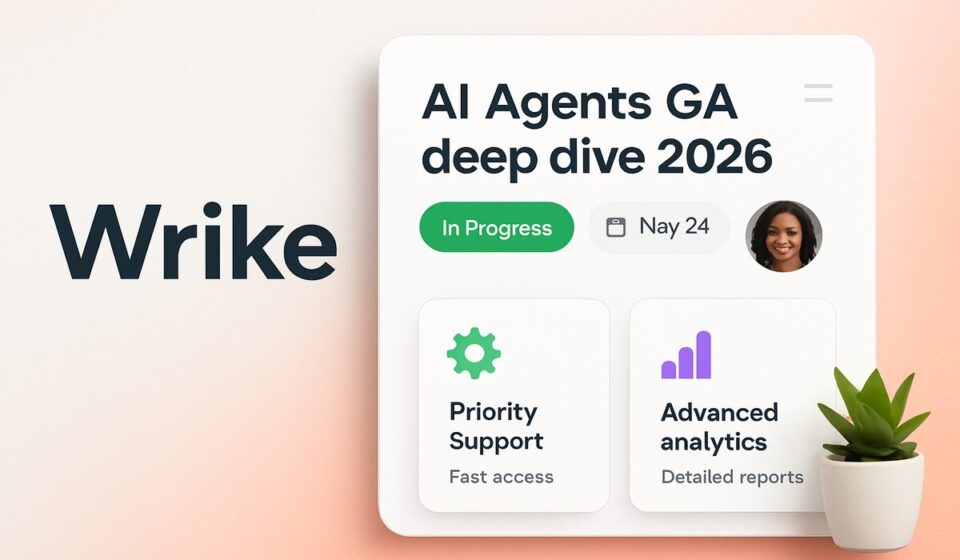

- Wrike AI Agents reached general availability in March 2026 — no code required, configured entirely through plain English descriptions.
- Agents execute multiple sequential actions from a single trigger; individual action failures do not cascade and halt the rest of the workflow.
- Location-based actions (April 2026) let agents move or add tasks to folders based on content, status, or AI reasoning — two distinct modes with different behavior.
- Wrike’s AI Accountability standard, announced at Springboard 2026, provides auditable agent logs — a capability no other major work management platform currently matches.
- AI Agents are available on Business and Enterprise plans; the AI Accountability audit log features are Enterprise-tier.
Wrike AI Agents Deep Dive 2026: How the Generally Available Agents Actually Work
Wrike AI Agents 2026 reached general availability in March 2026, letting teams configure autonomous task automation using plain language — no code needed. Agents run sequential multi-action workflows from a single trigger, support folder-based location routing added in April 2026, and are backed by Wrike’s industry-first AI Accountability audit log for enterprise compliance.
- What Changed in March 2026: General Availability Explained
- How Wrike AI Agents 2026 Actually Work
- How to Configure Agents via Natural Language (Step-by-Step)
- April 2026 Update: Location-Based Agent Actions
- AI Accountability: Wrike’s Audit Log Standard
- Pricing Tiers and Plan Requirements
- Enterprise Use Cases and Real-World Impact
- Verdict
- FAQ
If you’ve been tracking Wrike AI agents 2026 since the early beta announcements, the March general availability release marks a genuine inflection point — not just a feature refresh. As someone who has evaluated Wrike at the enterprise level across multiple client deployments, I can tell you the difference between “AI-assisted” and “AI-agentic” is not marketing copy. It’s an architectural shift in how work gets routed, escalated, and completed without human intervention at every step.
This guide covers everything that matters: what actually changed in March 2026, the mechanics of the sequential multi-action model, the April location-routing update, Wrike’s AI Accountability positioning, and how all of this maps to pricing tiers your procurement team will ask about.
What Changed in March 2026: General Availability Explained
Prior to March 2026, Wrike’s AI agent capabilities existed in limited preview. Access was gated, configuration required navigating technical setup steps, and the feature set was incomplete enough that most enterprise customers held off on deploying them in production workflows.
The March 2026 GA release changed three things that matter operationally:
1. Natural Language Configuration Replaces Code
The most significant shift is that agents are now configured entirely through plain English descriptions. You describe what the agent should monitor and what actions it should take, and Wrike’s underlying AI model translates that intent into executable logic. There is no formula editor, no JSON configuration, and no API calls required. A project manager with no technical background can stand up a working agent in under five minutes.
This is not just a UX improvement. It democratizes who can build automations inside an organization, moving configuration out of IT’s backlog and into the hands of the teams who understand the workflow best.
2. Sequential Multi-Action Execution from a Single Trigger
Before GA, agents were largely single-action constructs — one trigger, one response. The March release introduced true sequential execution: a single trigger event can now kick off a chain of multiple actions, executed in order. The critical engineering detail here is fault isolation: if one action in the sequence fails, the remaining actions continue independently. The workflow does not halt at the point of failure.
In practice, this means an agent triggered by a task status change can simultaneously update a custom field, notify a stakeholder via @mention, move the task to a new folder, and log a comment — all from that one trigger, with each action standing on its own.
3. Production Stability and Broader Availability
GA means Wrike is committing to SLA-backed reliability, not preview-tier best-effort uptime. Enterprise customers can now include AI agents in business-critical workflows with the same confidence they’d apply to native Wrike automations.
Official reference: Wrike’s AI Agents Help Center documentation covers the full configuration interface introduced at GA. The Wrike blog announcement provides the product narrative behind the March 2026 release.
How Wrike AI Agents 2026 Actually Work
Understanding the mechanics of Wrike AI agents 2026 is essential before deploying them, because the architecture determines what they can and cannot reliably do.
The Trigger-Action Model
Every agent is built on a trigger-action model. A trigger is a workspace event — a task created, a status changed, a due date passing, a comment added, a custom field value updated. When the trigger fires, the agent evaluates the conditions you’ve described in natural language and decides whether to execute its action sequence.
The AI layer sits between trigger evaluation and action execution. It’s responsible for interpreting ambiguous conditions (e.g., “if the task description mentions a client deliverable”) and mapping them to concrete workspace operations. This is what distinguishes an AI agent from a traditional automation rule: rule-based automations require exact field matches; agents can reason about content.
Sequential vs. Parallel Execution
Actions within a single agent run sequentially, not in parallel. Order matters when one action’s output feeds into the next — for example, setting a custom field value before using that value to determine a folder destination. The fault isolation model means each action is treated as an independent operation; a failed API call to an integration won’t prevent a downstream comment notification from being posted.
What Agents Can Act On
At GA, Wrike AI agents can perform actions across the following categories:
- Task management: Create, update, assign, duplicate, or close tasks
- Field updates: Modify custom fields, status fields, priority, and effort
- Communication: Post comments, @mention users or user groups, send in-app notifications
- Location management: Move tasks to folders, add tasks to additional folders (introduced April 2026 — covered in detail below)
- Relationship management: Add dependencies, link related tasks, attach items to requests
Consultant’s note: Agents do not yet support outbound webhook triggers to third-party systems as a native action — that still requires pairing with Wrike’s traditional automation rules or integration layer. Know this boundary before scoping agent-dependent workflows with external tools.
How to Configure Wrike AI Agents via Natural Language (Step-by-Step)
The configuration interface is deliberately minimal. Here is the exact process as of the March 2026 GA release:
- Navigate to the Automation panel. From your Wrike workspace, open the space or project where you want the agent to operate. Access Automation from the project settings menu (gear icon, then “Automations”).
- Select “Create Agent” (not “Create Rule”). The interface now distinguishes between traditional rule-based automations and AI agents. Agents appear under a separate tab labeled “AI Agents” in the automation builder.
- Write your trigger description in plain English. Type what should cause the agent to activate. Example: “When a task in this project is moved to the ‘In Review’ status and has been in that status for more than 24 hours.” Wrike’s AI will parse and confirm its interpretation before saving.
- Describe each action you want the agent to perform. Add actions one at a time using natural language. Example action 1: “Assign the task to the QA team user group.” Example action 2: “Post a comment tagging the task owner saying review has been pending for over a day.” Actions are sequenced in the order you add them.
- Set scope and conditions. Define whether the agent applies to all tasks in the project, tasks matching specific criteria (assignee, tag, custom field value), or tasks created after a specific date. This is also in natural language: “Only apply this to tasks tagged ‘client-facing.’”
- Preview the agent logic. Wrike surfaces a plain-English summary of what it understood your agent to do. Review this carefully — discrepancies between your intent and the summary reveal ambiguities you should resolve before activating.
- Activate and monitor. Toggle the agent on. It runs in the background against real workspace activity. The agent log (visible in the automation panel) records every trigger event, whether conditions were met, and which actions fired or failed.
For teams new to agentic workflows, I recommend starting with a single-action agent in a low-stakes project before building multi-action sequences. The configuration interface handles complexity well, but the debugging experience — tracing why an agent didn’t fire — still benefits from having a simple baseline to compare against. See also our guide on Wrike Automations: Rules vs. AI Agents Explained for a deeper comparison of when to use each approach.
April 2026 Update: Location-Based Agent Actions
One month after the March GA release, Wrike shipped a significant capability expansion: location-based agent actions. This feature deserves detailed treatment because the two modes behave very differently, and conflating them causes misconfigured workflows.
Mode 1: Move to Location
The “Move to Location” action removes the task from its current folder and places it in a new folder. This is a destructive move — the task will no longer appear in its original location. Use this when a task completing a phase should be archived into a phase-specific folder, or when a project handoff means the task genuinely changes ownership in your folder hierarchy.
Example configuration: “When a task is marked Complete and its custom field ‘Department’ is set to ‘Finance’, move it to the Finance – Completed Tasks folder.”
Mode 2: Add to Location
The “Add to Location” action adds the task to an additional folder without removing it from its current location. Wrike’s folder model supports a task existing in multiple folders simultaneously — this action exploits that capability. Use it when a task needs cross-functional visibility: it stays in the originating project folder while also appearing in a shared portfolio or executive dashboard folder.
Example configuration: “When a task is assigned priority ‘High’ and its description mentions ‘executive sponsor’, add it to the Leadership Visibility folder.”
| Dimension | Move to Location | Add to Location |
|---|---|---|
| Effect on original folder | Task removed from original | Task stays in original |
| Multi-folder visibility | No — single location after move | Yes — task exists in multiple folders |
| Primary use case | Phase transitions, handoffs, archiving | Cross-team visibility, portfolio rollups |
| Reversible by agent? | Only if a reverse-trigger agent exists | Can be removed from additional folder |
| Risk of duplication confusion | Low | Medium — teams must understand multi-folder model |
Both modes support AI-driven condition evaluation. The agent can route tasks based on free-text analysis of the task description, not just field values — which is the key differentiator from Wrike’s traditional rule-based folder automations. For a broader look at how location routing fits into project portfolio management, see our piece on Best Project Portfolio Management Tools 2026.
AI Accountability: Wrike’s Audit Log Standard for Enterprise Compliance
On April 30, 2026, Wrike announced the AI Accountability standard at its Springboard 2026 customer conference. This is the announcement that changes the enterprise conversation around AI agents in work management software.
What the AI Accountability Standard Covers
Wrike positions itself as the only major work management platform with auditable AI agent logs — a tamper-evident, queryable record of every decision an AI agent made, including:
- The trigger event that activated the agent (timestamp, workspace item, user context)
- The conditions evaluated and whether they were met
- Each action attempted, with success/failure status and reason codes
- The AI model’s reasoning summary for content-based decisions (e.g., why a task description was classified as “client-facing”)
- The identity of the agent owner who configured the logic
Why This Matters in Practice
Enterprise compliance teams face a genuine problem with AI automation: when an autonomous agent takes an action that affects a regulated process — routing a contract task, escalating a risk item, modifying a compliance-tagged deliverable — the audit trail must be able to answer “who authorized this, and why did it happen?” With traditional automation rules, the answer is a rule ID. With AI agents making content-based decisions, the answer requires insight into the AI’s reasoning.
Wrike’s audit log surfaces that reasoning in plain English alongside the structured action log. During a compliance review, an auditor can pull the log for a specific task and see the exact sequence of events: trigger fired at 14:32 UTC, agent evaluated task description as matching the “contract review” pattern, moved task to Legal Pending folder, posted comment to @legal-team. That is an audit trail that holds up.
Competitive Context
As of May 2026, competing platforms including Asana, Monday.com, ClickUp, and Notion have shipped AI features of varying depth — but none have published an equivalent AI Accountability framework with queryable reasoning logs. This is Wrike’s explicit competitive positioning, and it is the right argument for regulated industries: financial services, healthcare, professional services, and government contractors.
Procurement checklist point: When evaluating AI agents for compliance-sensitive workflows, ask any vendor for their AI action audit log documentation. If they cannot provide reasoning-level transparency alongside action records, the agent is not deployable in regulated processes without additional governance controls layered on top.
For a deeper comparison of how Wrike stacks up on governance features, see our Wrike vs. Asana Enterprise Comparison 2026. For the official Wrike Springboard announcement, see the Wrike Springboard 2026 blog post.
Pricing Tiers and Plan Requirements
AI agent access in Wrike is not flat across all plans. Here is how it maps as of May 2026:
| Feature | Free | Team | Business | Enterprise |
|---|---|---|---|---|
| AI agent creation | ✗ | ✗ | ✓ | ✓ |
| Natural language configuration | ✗ | ✗ | ✓ | ✓ |
| Sequential multi-action agents | ✗ | ✗ | ✓ | ✓ |
| Location-based actions | ✗ | ✗ | ✓ | ✓ |
| AI Accountability audit logs | ✗ | ✗ | Limited | ✓ Full |
| Agent reasoning log export | ✗ | ✗ | ✗ | ✓ |
The practical implication: if your organization’s primary driver for adopting AI agents is compliance and audit log access, you need Enterprise. Business-tier customers can build and run agents but get a simplified action log without the reasoning-level detail that makes the AI Accountability standard meaningful for regulated workflows.
For teams on Business tier evaluating an upgrade, the key question is whether your risk and compliance team requires reasoning transparency or whether action-level logging is sufficient. In most non-regulated use cases, Business-tier logging is adequate.
Enterprise Use Cases and Real-World Business Impact
The configuration flexibility of Wrike AI agents in 2026 means the use case list is genuinely broad. The following are the patterns I have seen work most reliably at the enterprise level:
1. Intake Triage and Routing
Marketing and operations teams handling high-volume request intake — campaign briefs, IT service requests, procurement submissions — can configure agents to read incoming task descriptions and route them to the correct team folder and assignee without human triage. An agent monitoring a shared intake folder can evaluate request type from free-text description and assign accordingly within seconds of submission.
2. Escalation Workflows
Agents excel at time-based escalation. Configure an agent to monitor high-priority tasks approaching due date and automatically escalate: reassign to a senior resource, notify a project sponsor via comment, and update a risk register field. The sequential action model means all three steps happen from a single trigger without building three separate rules.
3. Cross-Project Portfolio Visibility
Using the “Add to Location” mode introduced in April 2026, program managers can configure agents to automatically surface tasks of strategic importance into a portfolio-level folder as they are created or reach key status milestones. Executives see a curated, always-current view without anyone manually maintaining it.
4. Compliance Workflow Gating
For regulated industries, agents can enforce process gates: when a deliverable task moves to “Complete,” an agent verifies the required approval field is populated and, if not, resets status and notifies the responsible party. The AI Accountability log provides the evidence trail that the gate was enforced consistently.
5. Post-Project Archiving
When a project status changes to Closed, an agent can automatically move all tasks in the project to an archive folder structure, strip assignees, and post a close-out summary comment referencing relevant dates. What used to require a 20-minute manual checklist becomes zero-touch.
For broader context on how AI-driven automation fits into modern project delivery, see our overview of AI-Powered Project Management Tools: 2026 Landscape and our guide on Workflow Automation in Work Management: A Practitioner’s Guide.
Wrike AI Agents 2026 is a materially capable, production-ready feature set — not a preview-tier experiment. The natural language configuration genuinely lowers the barrier to automation, the sequential multi-action model with fault isolation is architecturally sound for complex workflows, and the April location-routing update addresses a real gap in how tasks move through project structures. The AI Accountability standard is the strongest enterprise governance argument in the work management category as of mid-2026 — if your organization operates in a regulated industry, this alone may justify an Enterprise tier evaluation. The primary limitation is that Enterprise-tier pricing is required to unlock the full audit log and reasoning transparency that makes the accountability story complete. For Business-tier customers, the agent capabilities are strong; the compliance narrative requires an upgrade conversation.
Frequently Asked Questions
What is the difference between Wrike AI Agents and traditional Wrike automation rules?
Traditional automation rules in Wrike are condition-action pairs based on exact field matches — if a specific field equals a specific value, take a predefined action. AI agents evaluate conditions using natural language reasoning, meaning they can interpret task descriptions, comment content, and ambiguous criteria that cannot be expressed as exact field matches. Agents also support sequential multi-action execution from a single trigger, whereas traditional rules are one-to-one. Both can coexist in the same workspace and complement each other.
Do Wrike AI Agents require any coding or technical configuration?
No. As of the March 2026 general availability release, agents are configured entirely through plain English descriptions. You describe the trigger condition and each action in natural language, and Wrike surfaces a confirmation summary of what it understood before you activate the agent. No API calls, formula editors, or JSON configuration are involved in the standard setup flow.
What happens when one action in a multi-action agent fails?
Wrike’s sequential agent model uses fault isolation: if one action in the sequence fails, the remaining actions continue to execute independently. The agent log records the failure with a reason code for the failed action, but the workflow is not halted entirely. This is a deliberate design decision that prioritizes workflow continuity over strict all-or-nothing execution — appropriate for most work management contexts where partial completion is better than complete stoppage.
What is the difference between “Move to Location” and “Add to Location” in Wrike AI agent actions?
“Move to Location” removes a task from its current folder and places it in a new one — the task no longer appears in its origin location. “Add to Location” adds the task to an additional folder without removing it from the original, exploiting Wrike’s multi-folder task model. Use Move for phase transitions and archiving; use Add for cross-team visibility and portfolio rollups where the task needs to remain visible in its originating context.
Which Wrike plan is required to access AI Agents and the AI Accountability audit log?
AI Agent creation and the core configuration capabilities are available on Business and Enterprise plans. The full AI Accountability audit log — including reasoning-level transparency for content-based agent decisions and the ability to export audit records — is an Enterprise-tier feature. Business-tier customers receive a simplified action log but do not have access to the reasoning summaries or export functionality required for formal compliance workflows.
Sponsored