
Most ClickUp automations fail for one of three reasons: your Workspace hit its monthly Action limit and every automation paused, ClickUp deactivated the rule after five failures in a week, or the trigger never fires on the event you had in mind. Check the Activity tab before changing anything — it separates rules that failed from rules that never ran.
Start with the Activity tab, not with the automation
The most common mistake is opening the broken automation and editing it. You lose the evidence. ClickUp logs every run with a status, and that status narrows the problem before you touch a setting.
- In the upper-left corner, click your Workspace avatar.
- Select Automations.
- Select the Activity tab. It defaults to filtering by your current location.
- Set Location to where the automation was created — not where the task lives.
- Set Date run to cover the period it should have fired, then use Status to isolate Failed and Skipped runs.
Read the result this way. Failed means the trigger fired and a step broke — permissions, an integration, a Custom Field. Skipped means the trigger fired but the criteria were not met, which points at a Condition. Nothing at all is the most informative outcome: the trigger never fired, so rewriting the Action will not help. One exception, which matters later — if the creator has no access to the trigger task, ClickUp neither runs the rule nor logs it.
Cause 1: Your Workspace burned through its monthly Actions
This is the most frequent cause and the most confusing symptom, because it does not break one automation — it stops all of them. When the Workspace exceeds its monthly Action allowance, ClickUp pauses Automations for the rest of the month. Limits reset on the first, Pacific Time.
| Plan | Total active Automations | Actions per month | Integration Automations and webhooks |
|---|---|---|---|
| Free Forever | 5 | 100 | No |
| Unlimited | 500 | 1,000 | No |
| Business | Unlimited | 5,000 | Yes |
| Enterprise | Unlimited | 250,000 | Yes |
Two notes. ClickUp’s limits article also lists a Business Plus row at 25,000 Actions per month, but Business Plus is absent from the public pricing page, which currently shows only the four tiers above. If an older post tells you to buy it, confirm with ClickUp sales.
Second: 1,000 Actions per month on Unlimited is far less generous than it reads. Every triggered automation counts as a use, and a busy List with an intake form and a status-driven notification chain can clear a thousand runs in a fortnight.
To check where you stand, from a Space, Folder, Subfolder, or List:
- Click the Automate button or the lightning bolt icon.
- Click Manage Automations.
- Click the Usage tab.
- Read Total actions used for the monthly figure and Total active rules for your remaining automation headroom.
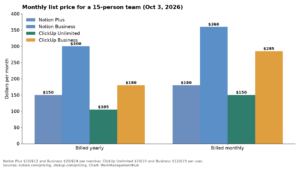
The Usage tab refreshes every ten automation uses, so treat it as approximate. ClickUp emails owners and admins at 90% and 100% of the allowance — if those alerts go to someone who left, fix that today. Upgrading is not the only answer: inactive automations do not count toward your active total, so deactivating stale experiments buys headroom for free. Business is $12 per user per month billed yearly or $19 monthly, against Unlimited at $7 and $10 — a real jump for a small team whose only need is more Actions.
Cause 2: ClickUp deactivated the automation after repeated failures
ClickUp has a circuit breaker and most teams do not know it exists. If the same automation fails more than five times in one week with the same error, ClickUp deactivates it so the failures stop consuming your allowance. An email goes to whoever created it, or to the Workspace owner if that person has left. Email and Custom Field errors are treated as more serious: ClickUp emails immediately and deactivates.
So a rule built by a contractor who has since offboarded can switch itself off silently. When someone reports that a workflow “just stopped”, check the Inactive tab first:
- From the location where it was created, click Automate, then Manage Automations.
- Select the Manage tab.
- Below the location switcher, click Inactive.
- Find the rule, click the pencil icon, and fix the underlying error.
- Use the Off/On toggle in the automation’s upper-right corner to re-enable it.
Re-enabling without fixing the cause just restarts the five-strike count.
Cause 3: The trigger never fires on the event you have in mind
Most wasted debugging time goes here, because a trigger that silently never matches looks identical to a broken automation. ClickUp’s triggers carry documented exclusions that are invisible in the builder.
| Trigger | Fires on | Does not fire on |
|---|---|---|
| Comment is added | A new comment on the task | Threaded replies to an existing comment |
| Assignee added | An assignee added to an existing task | An assignee set from the task creation menu |
| Custom Field changes | A field value changing on a task | Values set by applying a template; Formula Fields using Today() |
| Every… | A scheduled day and time, across the List | Closed or completed tasks |
| Existing task or subtask added to this location | A task added to the location | Subtasks whose parent was added; only Subtasks in Multiple Lists counts |
| Due date arrives; Date is Before/After | 4 am local time on the date | Any other time — and the timezone used is the automation creator’s, not the assignee’s |
That last row causes real damage. A rule built in Sydney to nudge a team in Chicago fires at 4 am Sydney time, and nobody notices for weeks.
Cause 4: The creator lost access, and the failure is invisible
ClickUp automations do not run as a service account. They run against the permissions of whoever created them, which makes offboarding and permission cleanups a recurring source of silent breakage.
For automations that add tasks to a List, the creator needs full edit access to the destination List at the moment of creation. If their access is later downgraded to edit, comment, or view only, the existing rule keeps working — they just cannot pick that List in new ones. If their access is removed, the automation fails and the failure appears in the audit log.
The dangerous case is on the trigger side. If the creator has no access to the trigger task — a private task, say — the automation does not run and nothing is written to the log. When a rule works for most tasks in a List but consistently skips a handful, check who built it and whether those tasks are private. The fix is organisational: build critical automations from an account that will not be deprovisioned, and audit departing staff’s rules during offboarding.
Cause 5: There is no “when the task changes” trigger
People arrive from Jira or Monday expecting a catch-all change trigger and try to approximate it. ClickUp does not have one. Each automation gets exactly one trigger, alongside up to 15 Conditions and 6 Actions.
Status changes is usually the trigger people actually want, and it hides a trap. Both the from and to dropdowns let you pick status groups rather than individual statuses, and a group matches every status inside it — rarely what you meant. Click the caret icon to the right of a group to specify individual statuses.
Conditions are also Business-and-above only. On Free Forever and Unlimited you cannot filter a trigger at all, so “it runs on tasks it should ignore” is a plan limitation, not a bug. Our guide to building ClickUp automations covers how to work around that.
Cause 6: The automation is switched off, or lives elsewhere in the hierarchy
Automations are location-specific and invisible from Everything view. A rule created on a List does not appear when you open the Automations modal from the parent Folder. Teams routinely rebuild a rule at List level, forget the Space-level original, then wonder why every task gets two comments.
There is no ordering by hierarchy, and creation order means nothing either. Automations sharing a trigger all fire simultaneously. If you need sequence, chain them — make the first automation’s Action the second one’s trigger.
- Open Manage Automations from the List where the problem appears.
- In the upper-left corner, click the location name to open the switcher.
- Check the parent Folder, Subfolder, and Space in turn.
- Use the Trigger filter to show every rule sharing that trigger.
- Deactivate duplicates rather than deleting them, so you can restore them if you guessed wrong.
Cause 7: Custom Field triggers and edits that do not count as changes
Custom Field triggers are the least predictable part of ClickUp automation. Two documented exclusions both bite: changes made by applying a template trigger nothing, and Formula Fields using Today() are unsupported.
Bulk edits are the question everyone asks, and ClickUp’s docs publish no definitive answer. Test it rather than trusting a blog post: build a throwaway automation with a comment Action, bulk-edit three tasks, and check the Activity tab for three runs before designing a process around bulk updates.
When you do use them, click Advanced in the trigger configuration to control whether the rule applies to newly created tasks, existing ones, or both. The default catches more than people expect and quietly eats Actions.
Cause 8: Slack and email break independently of the automation
An automation posting to Slack or sending email has two points of failure, and the ClickUp side often looks healthy while delivery fails. Integration Automations are Business-plan-only: on Free Forever and Unlimited, task webhooks, Automation integrations, and Chat webhooks are unavailable, so if the Slack step never appears in the builder, that is your answer.
Email automations fail most often because the connected account needs reauthorising, which happens silently after a password change or OAuth expiry. To restore it:
- In the location of your automation, open a task.
- Click the comment area.
- Select the email icon.
- In the From section, click the email address.
- Click Manage accounts.
- Hover over the inactive account and select Restore account.
- Complete the authorisation prompts, then test the automation.
For Slack, confirm the workspace-level integration is connected before debugging the rule. Automated direct messages also appear to come from a bot unless you tick Send as User? — a detail that has quietly undermined more than one “personal” nudge. Our ClickUp and Slack integration walkthrough covers the setup; if the problem spans several apps, start with ClickUp integrations not syncing.
Where ClickUp Automations genuinely fall short
The one-trigger limit is the real constraint. Any workflow meaning “do this when either of two unrelated things happens” becomes two automations: two rules to maintain, two audit trails, double the Action consumption. There is no branching, no if/else inside a rule, so complex approval routing degenerates into a sprawl of near-identical rules.
Debugging history is thin where you need it most. Free Forever, Unlimited, and Business retain one day of usage history, so an automation that misbehaved on Friday and gets reported on Monday leaves no evidence. Enterprise retains six months; ClickUp’s limits article also lists 30 days for Business Plus, which is not sold on the public pricing page. There is also no versioning: you can see who last updated a rule, but not what they changed.
For workflows needing conditional branching, error handling, or retries, a dedicated layer such as Make or Zapier driving ClickUp through its API is more durable, with native automations reserved for in-app housekeeping. Asana’s rules engine handles multi-branch logic more gracefully while trading away ClickUp’s breadth — our ClickUp versus Asana comparison covers that trade.
Frequently asked questions
Do inactive automations count toward my plan’s limit?
No. Only active automations count toward the total your plan allows — inactive ones are free. That makes deactivating unused rules the fastest way to create room on Free Forever’s limit of five, or Unlimited’s 500, without paying for an upgrade you may not need.
Why did my automation run twice on the same task?
Almost always because two rules share a trigger. Automations at Space, Folder, and List level all fire independently and simultaneously, with no hierarchy ordering. Filter Manage Automations by trigger across each parent location and deactivate the duplicate rather than deleting it.
Can I control the order automations run in?
Not directly. ClickUp runs neither by hierarchy nor by creation order, though Actions inside a single automation do run in the order you list them. To enforce sequence across rules, chain them: make the first automation’s Action the event that triggers the second.
How long does ClickUp keep automation history?
Free Forever, Unlimited, and Business plans store one day of activity; Enterprise stores six months. ClickUp’s limits article also lists 30 days for a Business Plus tier that is absent from the public pricing page. Plan troubleshooting around that: on Business and below, investigate the same day or the evidence is gone.
Why is there no Automate button in my Workspace?
The Automations ClickApp has not been enabled. A Workspace owner or admin must activate it in Workspace settings before anyone sees the button. Guests cannot create automations at all, and limited members can only build them where they hold edit or full edit permissions.
If rules fire correctly but the data they act on looks wrong, the problem is upstream — start with how ClickUp time tracking records entries for anything using the Time tracked trigger. On limits and trigger behaviour, only ClickUp’s own references are worth trusting: Automations feature availability and limits, Use Automation Triggers, and View your Automations activity.
Sponsored