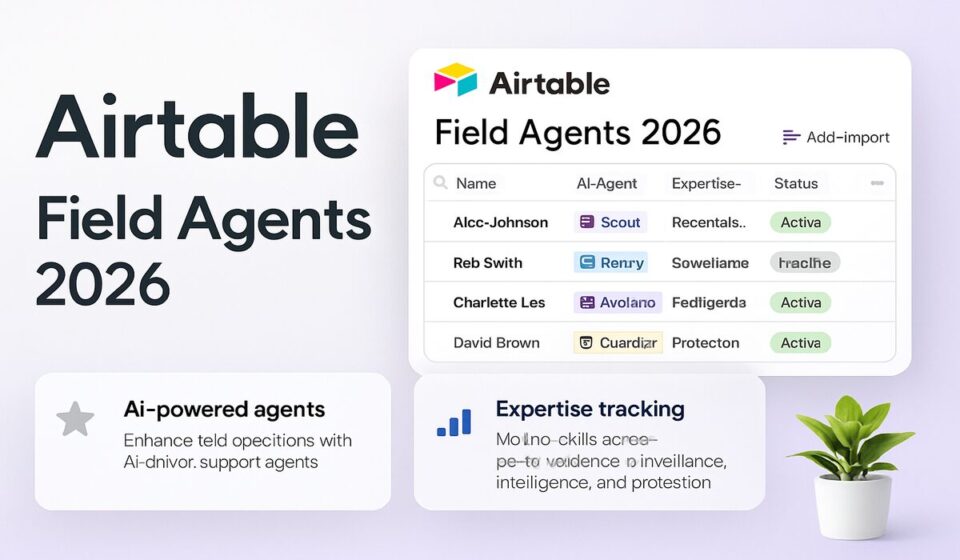

- Airtable Field Agents now support 16 tool connectors as of April 2026 — including Gmail, Outlook, HubSpot, Zendesk, Jira Cloud, Linear, Microsoft Teams, and Zoom — a dramatic expansion from the 3 available at launch.
- Field Agents run automatically on record creation or field changes — no human prompt required — which makes them categorically different from Airtable’s older AI fields and chatbot-style assistants.
- Airtable’s Omni AI builder can scaffold your Field Agent’s full table schema and instructions through a conversational interface, reducing initial setup time from hours to minutes.
- Building and configuring agents with Omni does not consume AI credits — credits are only used when an agent actively processes data, calls an API, or generates output.
- Most published guides are already outdated — they cover the basic web-search use case from pre-April 2026 and miss the Omni-assisted setup flow entirely.
To set up an Airtable Field Agent in 2026, open your base, add a new field, select “AI Field” then “Field Agent,” connect your desired tool connectors (up to 16 now available), write your agent instructions, and set the trigger condition — either record creation or a field change. Use Omni to scaffold the schema conversationally before you start.
- What Are Airtable Field Agents — and Why the 2026 Expansion Changes Everything
- Field Agents vs. AI Fields: The Critical Difference You Must Understand
- How to Use Omni to Scaffold Your Field Agent Setup in Minutes
- Airtable Field Agents Setup 2026: Complete Step-by-Step Guide
- Connecting the 16 Tool Connectors: What’s Available and How to Authorize Each One
- Understanding AI Credit Consumption: Build for Free, Pay Only When Agents Run
- Three Real-World Field Agent Use Cases That Deliver Immediate ROI
- Airtable Field Agents Setup 2026: Common Mistakes and How to Fix Them
- Verdict
- Frequently Asked Questions
How to Set Up Airtable Field Agents in 2026: Step-by-Step Guide
If you are still relying on guides published before April 2026 to configure Field Agents, you are working with incomplete information. The Airtable Field Agents setup 2026 landscape changed substantially when Airtable expanded the available tool connectors from 3 to 16 and introduced Omni — the conversational AI builder that makes schema design fast and accessible even for non-technical operators. This guide covers the full picture: what actually changed, how the trigger model works, how to configure every connector category, and what the credit model means for your team’s budget.
What Are Airtable Field Agents — and Why the 2026 Expansion Changes Everything
Field Agents are autonomous AI workers embedded directly inside Airtable records. Unlike an automation that runs a fixed script, a Field Agent uses an LLM to reason about the data in a record, take action through connected tools, and write a result back to a designated field — all without human initiation.
At launch, Field Agents could call three tools: web search, Airtable record lookup, and a basic data-transformation function. Useful, but narrow. As of April 23, 2026, that list stands at 16 connectors:
- Communication: Gmail, Outlook, Microsoft Teams, Zoom
- CRM and support: HubSpot, Zendesk
- Engineering and project management: Jira Cloud, Linear
- Calendar: Google Calendar
- Productivity and search: Web search, Airtable record tools, and additional connectors across document and data platforms
For teams running mixed stacks — a sales team on HubSpot, an engineering team on Jira, and customer success on Zendesk — a single Field Agent can now bridge all three systems autonomously, triggered by a single record change. That is a qualitatively different capability than what shipped at launch, and it is why most existing guides are now obsolete.
For more context on how AI capabilities fit into Airtable’s broader roadmap, see our complete guide to Airtable AI features in 2026.
Field Agents vs. AI Fields: The Critical Difference You Must Understand
Before configuring anything, you need to be precise about what a Field Agent is not. Airtable has several AI-powered field types — summarize, classify, translate, generate text — and these are commonly conflated with Field Agents. They are fundamentally different systems.
Standard AI fields are reactive: a user opens a record, clicks a button, or runs a manual batch operation, and the field generates output. A human is always in the loop to initiate the action.
Field Agents are autonomous: they trigger on record creation or on a field change, run without any human prompt, and can take actions in external systems — not just generate text. The moment a new lead is added to your CRM table, a Field Agent can query HubSpot for company firmographics, check Linear for any open engineering issues related to that account, and write a prioritized briefing back to the record — before any human has touched it.
This distinction matters operationally. If you wire up a Field Agent incorrectly — for instance, pointing the trigger at a field that changes frequently due to unrelated automation — you will burn AI credits and create noise. Understanding the trigger model is step one of any Field Agent setup.
For a broader comparison of how Airtable’s interface and automation layers interact with Field Agents, see our Airtable interfaces guide for 2026.
How to Use Omni to Scaffold Your Field Agent Setup in Minutes
Omni is Airtable’s conversational AI builder, accessible from any base. Its most practical application for Field Agents is schema scaffolding — you describe your workflow in plain language, and Omni proposes the table structure, field types, and Field Agent instructions needed to support it. Critically, this scaffolding process does not consume AI credits.
- Open Omni from the base toolbar — click the purple sparkle icon in the top-right corner of any base to open the Omni side panel. If you do not see this icon, your workspace plan may not include Omni; check under Billing → Plan Features.
- Describe your agent’s workflow in plain language — for example: “I want an agent that runs when a new support ticket is created, pulls the customer’s HubSpot deal history, checks Zendesk for related open tickets, and writes a priority score to the record.” Be specific about inputs, outputs, and the systems involved.
- Review Omni’s proposed schema — Omni will suggest table fields, including the trigger field, the output field the agent will write to, and any lookup fields needed for context. Accept, modify, or reject individual suggestions inline.
- Accept the schema and open the Field Agent configuration panel — once you confirm, Omni creates the scaffolded table structure and drops you into the Field Agent setup flow with the instruction prompt pre-populated based on your description.
- Edit the pre-populated instructions — Omni’s draft is a starting point, not a finished product. Review the instruction text for accuracy, add constraints (e.g., “do not send any external communications without explicit approval”), and verify the tool connectors Omni selected match your intended workflow.
Teams that skip Omni and attempt to build Field Agent tables from scratch manually consistently report 2-4 hours of setup time for moderately complex workflows. Teams that use Omni report the same outcomes in under 30 minutes. Use it.
Airtable Field Agents Setup 2026: Complete Step-by-Step Guide
Once your schema is scaffolded — either via Omni or manually — use this sequence to configure the Field Agent itself. Every step below reflects the April 2026 interface.
- Open your base and navigate to the target table — Field Agents live at the field level inside a table, not at the base or workspace level. Make sure you are in the correct table before proceeding.
- Click the “+” button to add a new field — this opens the field type picker on the right-hand sidebar. Scroll down or search for “AI” to filter the AI field types.
- Select “AI Field” from the field type list — you will see several sub-types: Generate text, Summarize, Classify, Translate, and Field Agent. Select Field Agent.
- Name your Field Agent field — use a name that reflects the output, not the process. “Lead Briefing” is better than “Agent Output.” This field will be visible to all collaborators in the record.
- Set the trigger condition — in the “When to run” panel, choose either When a record is created or When a specific field changes. If you choose field change, select the exact field from the dropdown. Avoid triggering on formula fields that recalculate constantly — this is the single most common source of unintended credit consumption.
- Write your agent instructions — this is the system prompt the LLM receives. Be explicit: describe the task, the tools the agent is allowed to use, what it should write to the output field, and any constraints. Example: “You are a CRM research assistant. When a new lead is created: 1) Search HubSpot for the company domain using the ‘Company Website’ field. 2) Retrieve the most recent deal stage and owner. 3) Search Zendesk for any open support tickets associated with the domain. 4) Write a 3-sentence briefing summarizing deal status and support history to this field.”
- Add tool connectors — click Add tools in the instructions panel. A connector picker opens showing all 16 available integrations. Select the tools your instructions reference. Each connector requires a one-time OAuth authorization — see the next section for details.
- Add context fields — click Add context to specify which fields in the record the agent can read. Limit context to only the fields the agent needs. Providing unnecessary fields wastes tokens and can produce less accurate outputs.
- Test the agent on a sample record — click Test on this record to run the agent against an existing record without saving the field. Review the output in the preview panel. Iterate on the instructions until the output quality meets your standard before activating.
- Save the field and confirm activation — click Save field. Airtable will prompt you to confirm that the agent will run automatically going forward. Review the confirmation dialog — it shows estimated credit consumption per run based on your instructions and connected tools — then click Activate.
From this point, the Field Agent is live. Every new record creation or qualifying field change will trigger an autonomous run.
Connecting the 16 Tool Connectors: What’s Available and How to Authorize Each One
Tool connectors are the mechanism by which Field Agents reach into external systems. Authorization is workspace-level — once you authenticate a connector, any Field Agent in any base within the workspace can use it, subject to the permissions of the authenticated account.
The 16 connectors fall into four categories. Here is how to authorize each group:
Google Workspace (Gmail, Google Calendar):
- Open Workspace Settings → Integrations → Field Agent Connectors
- Click “Connect” next to Gmail or Google Calendar — you will be redirected to Google’s OAuth consent screen.
- Sign in with the service account or user account that has the appropriate send/read permissions, then click Allow.
- Verify the connection status shows “Connected” — a green indicator confirms the token is active.
Microsoft 365 (Outlook, Microsoft Teams):
- Open Workspace Settings → Integrations → Field Agent Connectors
- Click “Connect” next to Outlook or Teams — you will be prompted for Microsoft 365 admin consent if your tenant requires it.
- Complete the Microsoft identity platform OAuth flow — for Teams, ensure the authenticating account has the correct channel-posting permissions in your tenant.
CRM and support tools (HubSpot, Zendesk):
- Open Workspace Settings → Integrations → Field Agent Connectors
- Click “Connect” next to HubSpot or Zendesk — HubSpot uses its standard private app token flow; Zendesk uses OAuth with subdomain specification.
- For HubSpot: generate a Private App token in HubSpot → Settings → Integrations → Private Apps, then paste it into the Airtable connector field and click Verify.
- For Zendesk: enter your Zendesk subdomain and complete the OAuth redirect, then confirm the scopes include ticket:read and user:read at minimum.
Engineering tools (Jira Cloud, Linear):
- Open Workspace Settings → Integrations → Field Agent Connectors
- For Jira Cloud: click “Connect” → you will be redirected to Atlassian’s OAuth 2.0 flow. Select the specific Jira Cloud site you want to connect — the agent will only have access to that site’s projects and issues.
- For Linear: click “Connect” → Linear uses its standard OAuth app flow. Grant read access to issues and projects at minimum; grant write access only if your agent instructions include creating or updating Linear issues.
Video and communication (Zoom):
- Open Workspace Settings → Integrations → Field Agent Connectors
- Click “Connect” next to Zoom — you will be prompted to authorize the Airtable Zoom app from your Zoom account’s app marketplace page.
- Confirm the scopes — for meeting scheduling use cases, grant meeting:write; for read-only lookups, meeting:read is sufficient.
For the full connector authorization documentation, see Airtable’s official Field Agent connector reference.
Understanding AI Credit Consumption: Build for Free, Pay Only When Agents Run
Credit consumption is one of the most misunderstood aspects of the Airtable Field Agents setup process, and it has real budget implications for teams running high-volume tables.
The rule is simple but important: building and configuring agents with Omni consumes zero AI credits. You can iterate on schema, rewrite instructions, add and remove connectors, and run test previews without touching your credit balance. Credits only burn when an agent actively executes — meaning it has been triggered by a real record creation or field change and is actively calling tools, reading context fields, reasoning over data, and writing output.
Practical implications for planning:
- Prototype aggressively using Omni and test previews. There is no financial cost to exploration. Build multiple candidate configurations before activating any of them.
- Audit your trigger field selection carefully before activating. A Field Agent triggered by a formula field that recalculates on every related record change can run hundreds of times per day unintentionally. Always trigger on the most stable, human-initiated field change you can identify.
- Monitor credit consumption per agent by navigating to Workspace Settings → AI Usage → Field Agents. Airtable breaks down credit usage by field name and table, so you can identify runaway agents quickly.
- Estimate costs before activation. The activation confirmation dialog shows an estimated credit cost per run based on your current instruction length, context field count, and connected tools. For a four-tool agent with 500 tokens of instruction and three context fields, expect roughly 800-1,200 credits per run at current consumption rates.
For teams concerned about credit usage at scale, Airtable’s official AI credits documentation provides the full consumption rate table by model tier.
Three Real-World Field Agent Use Cases That Deliver Immediate ROI
The 16-connector expansion makes Field Agents practical for cross-functional workflows that were simply impossible at launch. These three configurations represent the highest-value starting points based on current team deployments.
Use case 1: Inbound lead enrichment (HubSpot + web search)
Trigger: record creation in an Inbound Leads table. The agent queries HubSpot for existing company and contact data, runs a targeted web search for recent company news, and writes a 200-word briefing to the “Lead Context” field. Sales reps open a record and find a pre-researched brief waiting — no manual research required.
Use case 2: Support ticket triage (Zendesk + Jira Cloud + Linear)
Trigger: when the “Status” field changes to “Escalated.” The agent queries Zendesk for the full ticket thread, checks Jira Cloud for any linked bug reports, queries Linear for related engineering issues, and writes a structured escalation summary with recommended next steps. What previously required a 20-minute handoff call between support and engineering is reduced to a structured document generated in seconds.
Use case 3: Meeting follow-up generation (Zoom + Gmail + Google Calendar)
Trigger: when a “Meeting ID” field is populated. The agent retrieves the Zoom meeting transcript summary, drafts a follow-up email using Gmail’s compose API, and creates a follow-up event in Google Calendar. The drafted email and event details are written back to the record for human review and one-click send approval. This is not fully autonomous action — review is still in the loop — but it eliminates the most time-consuming drafting work.
For a deeper look at how multi-tool agents interact with Airtable’s interface layer, see our guide to Airtable Superagent multi-agent workflows in 2026.
Airtable Field Agents Setup 2026: Common Mistakes and How to Fix Them
Based on the most frequent failure patterns in Field Agent deployments, these are the issues worth knowing before they cost you credits or credibility.
- “Agent not triggering” — check the trigger field type — Field Agents cannot trigger on formula fields, rollup fields, or linked record fields. Only native field types (text, number, single select, date, checkbox) support triggering. If your intended trigger field is a formula, create a separate checkbox or date field that a prior automation populates, and use that as the actual agent trigger.
- “Agent output is blank or error state” — connector authorization has expired — OAuth tokens for Google, Microsoft, and HubSpot connectors expire. Navigate to Workspace Settings → Integrations → Field Agent Connectors and check for any connectors showing an “Expired” or “Reconnect” status. Re-authorize and then manually re-trigger the affected records.
- “Agent is running too frequently” — audit the trigger field for cascading changes — if a trigger field is being updated by an automation that itself runs on record changes, you can create a loop. Use Airtable’s automation run history (Automations → Run History) to identify if the trigger field is being updated by another automation, then break the loop by adding a conditional check.
- “Instructions producing inconsistent output” — reduce context field count — providing more context than the agent needs actually degrades output consistency by introducing noise. Start with the minimum viable context fields — typically 3-5 — and add fields only when testing reveals the agent is missing important data.
- “Connector returning no results” — verify scope permissions on the authorized account — agents inherit only the permissions of the account used during OAuth authorization. If the HubSpot account used for authorization does not have access to a specific pipeline, the agent cannot see it. Reauthorize using an account with the correct permissions, or adjust the HubSpot permission set for the connected account.
For a broader guide to Airtable automation issues and fixes, see our Airtable automations not working: fixes for 2026. If you are comparing Airtable’s agent capabilities against other platforms, our Notion vs. Airtable 2026 comparison covers where each tool’s autonomous AI capabilities currently stand.
For the most current official documentation on Field Agents, refer to Airtable’s Field Agents support documentation.
Airtable Field Agents are now genuinely production-ready for cross-functional teams, and the April 2026 expansion to 16 connectors is the inflection point that makes them worth deploying seriously. The combination of Omni-assisted setup (free to build, fast to prototype), autonomous event-driven triggers, and direct integrations into HubSpot, Zendesk, Jira, and Linear means you can eliminate entire categories of manual handoff work — not just speed them up. The credit model is fair: you pay only when agents run, not when you build. The one firm recommendation: invest time in your trigger field selection before activating. A correctly scoped trigger is the difference between an agent that runs 10 times a day with precision and one that burns your monthly credit allocation in 48 hours. Start with one high-value use case, validate it thoroughly, then expand. Field Agents reward deliberate deployment, not wholesale adoption.
Frequently Asked Questions
Do Airtable Field Agents work on all Airtable plans?
Field Agents are available on Airtable’s Team plan and above as of 2026. Free and Plus plan users do not have access to Field Agents, though they can use standard AI fields (summarize, classify, generate text) on plans that include AI credits. If you are on Team and do not see the Field Agent option in the field type picker, confirm that AI features have been enabled at the workspace level by an admin under Workspace Settings → Features.
Can a Field Agent send emails or create calendar events automatically, or does a human need to approve?
Field Agents can take autonomous action in connected systems — including sending emails via Gmail or Outlook, creating events in Google Calendar, and posting messages in Microsoft Teams — without human approval, if you configure the instructions that way. However, the recommended practice for communication-heavy workflows is to have the agent draft and write the content back to a record field, and use a separate Airtable automation with a button trigger to send after human review. Full autonomy is available but should be deployed deliberately, especially for external-facing communications.
How is a Field Agent different from an Airtable Automation that calls an AI step?
An Airtable Automation with an AI step runs a fixed, scripted sequence — the AI generates text at a specific point in a predetermined workflow. A Field Agent uses an LLM to reason dynamically about the record, decide which tools to call and in what order, and adapt its approach based on what it finds. Automations are deterministic; Field Agents are agentic. Use automations for predictable, multi-step sequences with fixed logic. Use Field Agents when the right sequence of actions depends on what the data actually says.
What happens to a Field Agent run if a tool connector goes down or returns an error?
If a connected tool returns an error during a Field Agent run, the agent will by default write an error state to the output field rather than leaving it blank. The error message includes the connector that failed and a brief reason code. You can inspect failed runs in the Field Agent run history — accessible by clicking the output field name and selecting “View run history.” Failed runs still consume a partial credit allocation for the reasoning steps completed before the error. For high-reliability workflows, build explicit fallback instructions into your agent prompt: “If the HubSpot connector returns an error, note the failure and proceed using only the available record fields.”
Can multiple Field Agents run on the same record simultaneously?
Yes. Multiple Field Agent fields can exist in the same table and will trigger independently based on their individual trigger conditions. Airtable queues concurrent runs and executes them in the order they were triggered. If two Field Agents both trigger on record creation and one agent’s output is context for the second agent, there is no guarantee the first will complete before the second starts — you should use a field-change trigger on the first agent’s output field as the trigger for the second agent to create a reliable sequence.
Sponsored