Skip to content
-
Subscribe to our newsletter & never miss our best posts. Subscribe Now!
Work Management Hub Work Management Hub

Expert Reviews, Comparisons & Guides for Smartsheet, Monday.com, Asana, ClickUp & More

Work Management Hub Work Management Hub

Expert Reviews, Comparisons & Guides for Smartsheet, Monday.com, Asana, ClickUp & More

  • Airtable
  • Asana
  • ClickUp
  • Jira
  • Monday.com
  • Notion
  • Smartsheet
  • Wrike
  • About
  • Contact
  • Airtable
  • Asana
  • ClickUp
  • Jira
  • Monday.com
  • Notion
  • Smartsheet
  • Wrike
  • About
  • Contact
Close

Search

  • https://www.facebook.com/
  • https://twitter.com/
  • https://t.me/
  • https://www.instagram.com/
  • https://youtube.com/
How-To GuidesWrike

Wrike Not Working? 8 Fixes for the Most Common Wrike Issues in 2026

By Shaik KB
May 31, 2026 17 Min Read
0

⚡ Key Takeaways

  • Always check status.wrike.com first — if Wrike is having an outage, no local fix will help.
  • Most login failures trace back to using an alias email instead of your primary registered email, or a stale SSO configuration.
  • Wrike only supports the two most recent versions of Chrome, Firefox, Edge, and Safari — an outdated browser is one of the top causes of UI failures.
  • Desktop app crashes and slow performance are almost always fixed by clearing the Wrike cache folder at %AppData%\Wrike (Windows) or ~/Library/Application Support/Wrike (Mac).
  • Mobile sync issues are frequently caused by near-full device storage or iOS Safari blocking cookies — both are quick fixes.
  • Missing notifications are usually a permissions issue at the OS or browser level, not a Wrike bug.
  • Integration sync failures (Jira, Salesforce, Slack, etc.) are commonly triggered by expired OAuth tokens — re-authorizing the connection resolves them in under two minutes.

Quick Answer:

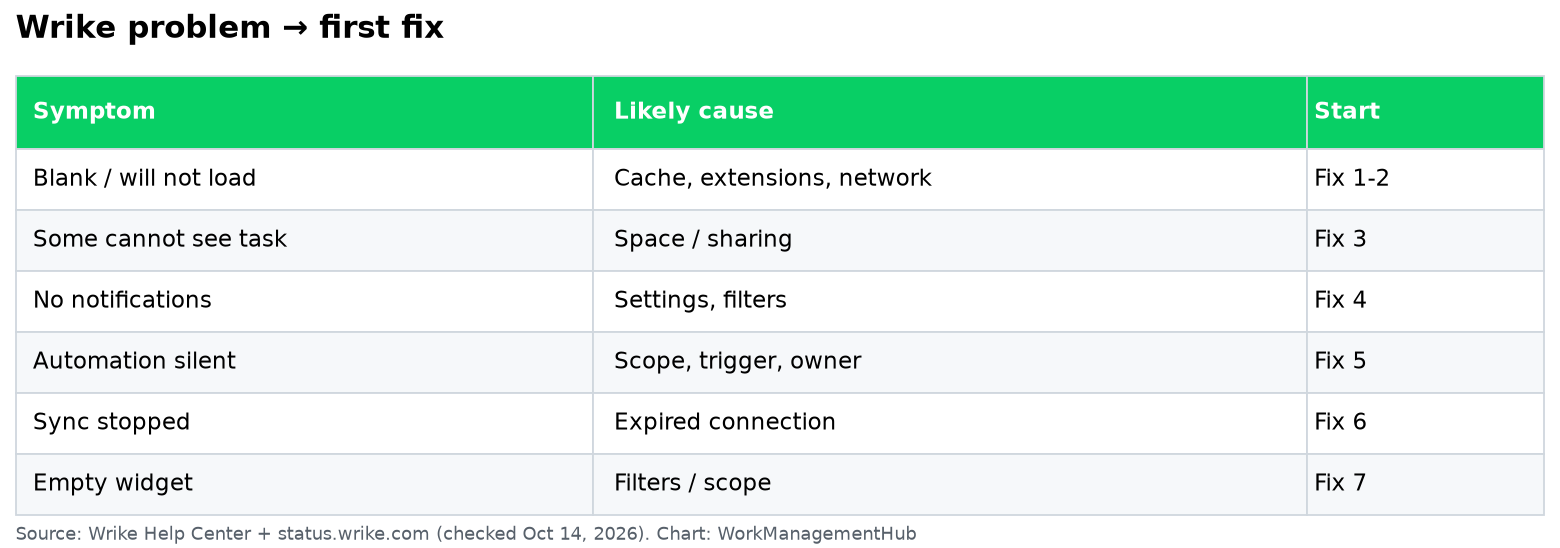
Wrike not working is usually caused by one of four things: an outdated browser, a corrupted local cache, an expired SSO or OAuth token, or an active platform outage. Start by checking status.wrike.com, then clear your browser cache, verify your login email matches your primary account, and update your browser to the latest version.

Table of Contents

  1. Is the Problem on Your End or Wrike’s End?
  2. Fix 1: Login and Authentication Failures
  3. Fix 2: SSO (Single Sign-On) Issues
  4. Fix 3: Browser Compatibility and Page-Load Failures
  5. Fix 4: Desktop App Cache and Performance Problems
  6. Fix 5: Mobile Sync Failures
  7. Fix 6: Notification Delivery Problems
  8. Fix 7: Integration Sync Failures
  9. Fix 8: Confirming and Surviving a Wrike Outage
  10. Verdict
  11. FAQ

Wrike Not Working? 8 Fixes for the Most Common Wrike Issues in 2026

If Wrike is not working for you right now, this guide gets straight to the solution. Whether the problem is a blank screen, a login loop, tasks that refuse to sync, or notifications that never arrive, every issue below has been documented and verified against Wrike’s 2026 platform behavior. Work through each fix in order or jump directly to the section that matches your symptom.

Is the Problem on Your End or Wrike’s End?

Before you touch a single setting, spend sixty seconds ruling out a platform-wide incident. When Wrike’s infrastructure is degraded, no amount of cache-clearing or reinstalling will fix it — you are simply waiting for their engineering team.

  1. Open status.wrike.com — Wrike’s official real-time status page. If any component shows “Degraded Performance,” “Partial Outage,” or “Major Outage,” that is your answer.
  2. Check independent monitors — StatusGator, IsDown, and OutageDown track Wrike incidents independently of Wrike’s own reporting. Search “Wrike” on any of these to see community-reported issues and historical uptime.
  3. Search social media — A quick search for “Wrike down” or “Wrike not working” on X (formerly Twitter) or Reddit often surfaces real-time reports from other affected users within minutes of an incident starting.
  4. Try a different network — Switch from your corporate Wi-Fi to a mobile hotspot, or vice versa. If Wrike loads on the second network, the problem is local to your network or firewall, not Wrike’s servers.
  5. Try a different device — Open Wrike on a second machine or phone. If it works there, the issue is device-specific and one of the fixes below will resolve it.

If status.wrike.com shows all systems green and the issue is device-specific, continue through the fixes below. If there is an active incident, bookmark the status page and check back every 15–30 minutes.

Fix 1: Wrike Not Working at Login — Authentication Failures

Login problems are the single most common Wrike complaint. The root causes are almost always one of three things: using the wrong email address, a password that does not match the primary account, or corrupted credential data stored in the desktop app.

Wrong Email Address (Most Common Cause)

Wrike ties your account to your primary registered email address. If your organization gave you a new email alias, changed your domain, or you have multiple Google accounts, you may be attempting to sign in with an address that has no Wrike account associated with it.

  1. Confirm your primary email — Log into your email client and search for “Welcome to Wrike” or “Wrike account.” The address that received that original invitation email is your primary Wrike login email.
  2. Avoid email aliases — If your company uses Google Workspace and you have aliases like firstname@company.com and f.lastname@company.com, only one of them is registered with Wrike. Use the exact address from step 1.
  3. Use the “Forgot password” link — At app.wrike.com, click “Forgot password” and enter your primary email. If the reset email arrives, that address is valid. If no email arrives within five minutes (including spam folder), that address is not registered.
  4. Contact your Wrike account admin — If you cannot identify the correct email, your workspace admin can look up your account in Account Management > Users and confirm or update the address.

Desktop App Losing Saved Credentials

  1. Quit the Wrike desktop app completely — On Windows, right-click the Wrike icon in the system tray and select “Quit.” On Mac, right-click the Dock icon and select “Quit.”
  2. Clear the app cache on Windows — Open File Explorer, paste %AppData%\Wrike into the address bar, and press Enter. Select all files and folders inside and delete them.
  3. Clear the app cache on Mac — Open Finder, press Cmd + Shift + G, enter ~/Library/Application Support/Wrike, and press Go. Select all contents and move them to the Trash.
  4. Relaunch the Wrike desktop app — You will be prompted to log in fresh. Enter your primary registered email and password.

Fix 2: Wrike Not Working with SSO — Single Sign-On Misconfiguration

Organizations using SAML 2.0-based SSO (Okta, Azure AD, Google Workspace, etc.) face a distinct set of login failures. SSO problems in Wrike fall into two categories: configuration errors on the identity provider side, and stale session tokens on the user side.

User-Side SSO Fixes

  1. Sign out of your identity provider entirely — If you use Okta, navigate to your Okta dashboard and click your profile icon > Sign Out. For Azure AD, go to myapps.microsoft.com and sign out. For Google Workspace, sign out of all Google accounts in your browser.
  2. Clear browser cookies and cache — In Chrome: Settings > Privacy and Security > Clear Browsing Data > check “Cookies and other site data” and “Cached images and files” > select “All time” > click “Clear data.” In Firefox: Settings > Privacy and Security > Cookies and Site Data > Clear Data.
  3. Attempt SSO login again — Navigate to app.wrike.com, click “Sign in with SSO,” enter your work email domain, and proceed through your identity provider’s flow.
  4. Try an incognito/private window — Open a private browser window (Chrome: Ctrl+Shift+N / Cmd+Shift+N) and attempt SSO login. If it works in incognito but not your normal browser, a browser extension is interfering (see Fix 3).

Admin-Side SSO Fixes

  1. Verify the SAML metadata has not expired — Log into Wrike as an admin, navigate to Account Management > Security > Single Sign-On. Check that the metadata URL or uploaded XML file is current. Many identity providers rotate certificates annually.
  2. Confirm the Assertion Consumer Service (ACS) URL — The ACS URL in your identity provider must exactly match the value shown in Wrike’s SSO settings. A trailing slash difference or HTTP vs. HTTPS mismatch will cause a silent redirect failure.
  3. Check the NameID format — Wrike requires the NameID to be the user’s email address in emailAddress format. If your identity provider is sending a persistent identifier or username instead, change the NameID attribute mapping in your IdP configuration.
  4. Test with a non-SSO admin account — Wrike allows at least one admin to log in with a standard email/password regardless of SSO settings. Use that account to access admin settings and diagnose the configuration without being locked out.
  5. Consult Wrike’s official SSO documentation for provider-specific setup guides (Okta, Azure AD, Google) with exact attribute mapping requirements.

Fix 3: Browser Compatibility and Page-Load Failures

Wrike’s web app only officially supports the two most recent major versions of Chrome, Firefox, Microsoft Edge, and Safari. Running an older browser version is one of the top causes of blank pages, broken UI elements, task panels that fail to open, and Gantt charts that refuse to render.

Check and Update Your Browser

  1. Check your current browser version — In Chrome or Edge, navigate to chrome://settings/help. In Firefox, go to Menu > Help > About Firefox. In Safari, go to Safari menu > About Safari.
  2. Update to the latest version — Chrome and Edge update automatically when you restart the browser. Firefox: click “Restart to update Firefox” on the About page. Safari: open System Settings > General > Software Update on Mac.
  3. Confirm the version is supported — After updating, revisit Wrike’s system requirements page to verify your browser version falls within the supported range. At time of writing, Wrike supports Chrome 124+, Firefox 125+, Edge 124+, and Safari 17+.

Clear Cached Data and Conflicting Extensions

  1. Hard-refresh the Wrike page — Press Ctrl+Shift+R (Windows/Linux) or Cmd+Shift+R (Mac) to force a full reload bypassing the cache. Do this before any deeper fix.
  2. Clear site-specific cache for Wrike — In Chrome, click the padlock/info icon in the address bar while on app.wrike.com > Site Settings > Clear Data. This clears only Wrike’s cached data without affecting other sites.
  3. Disable browser extensions one at a time — Ad blockers (uBlock Origin, AdGuard), VPN extensions, and password managers sometimes inject scripts that break Wrike. In Chrome: navigate to chrome://extensions, disable all extensions, reload Wrike, then re-enable extensions one by one to identify the culprit.
  4. Check firewall and antivirus settings — Wrike requires access to the following domains: app.wrike.com, *.wrike.com, wrke.io, and wrike.com. Corporate firewalls and endpoint security products (Sophos, CrowdStrike, Zscaler) sometimes block these. Whitelist all *.wrike.com subdomains and retry.
  5. Test in a different browser — If Wrike loads correctly in Firefox but not Chrome, the issue is browser-specific (likely an extension or browser profile corruption). Create a fresh Chrome profile via chrome://settings/people > Add and test Wrike there.

Fix 4: Wrike Desktop App Cache and Performance Problems

The Wrike desktop application is an Electron-based wrapper around the web app. It stores session data, cached assets, and user preferences locally. When this cache becomes corrupted — often after a system crash, forced update, or mid-sync shutdown — the app can freeze on launch, display a blank white screen, or run extremely slowly.

Full Cache Clear and Reinstall (Windows)

  1. Quit the Wrike desktop app — Right-click the Wrike icon in the system tray (bottom-right of taskbar) and select “Quit Wrike.”
  2. Uninstall Wrike via Control Panel — Open Control Panel > Programs > Uninstall a Program, find “Wrike,” and click Uninstall. Follow the prompts.
  3. Manually delete the Wrike cache folder — Open File Explorer and navigate to %AppData%\Wrike (paste this directly into the address bar). Delete the entire Wrike folder. Also check %LocalAppData%\Wrike and delete that folder if it exists.
  4. Delete Wrike from the Temp folder — Navigate to %Temp% in File Explorer and delete any folders or files beginning with “Wrike” or “wrike.”
  5. Download the latest Wrike desktop installer — Go to help.wrike.com, search for “desktop app download,” and get the current installer.
  6. Run the installer and log in — Complete installation and sign in with your primary registered email. The fresh install will rebuild the cache cleanly.

Full Cache Clear and Reinstall (Mac)

  1. Quit Wrike completely — Right-click the Wrike icon in the Dock > Quit. Or use Cmd+Q with Wrike in focus.
  2. Drag Wrike to the Trash from Applications — Open Finder > Applications, find Wrike.app, and drag it to the Trash. Do not empty the Trash yet.
  3. Delete the application support folder — Press Cmd+Shift+G in Finder, enter ~/Library/Application Support/Wrike, and press Go. Move the entire Wrike folder to the Trash.
  4. Delete cached data — Navigate to ~/Library/Caches/ and delete any folder named “com.wrike.desktop” or similar Wrike-named cache directories.
  5. Delete saved credentials from Keychain — Open Keychain Access (Applications > Utilities > Keychain Access), search for “Wrike,” and delete any saved Wrike entries.
  6. Empty the Trash and reinstall — Empty the Trash, then download and install the latest Wrike desktop app from help.wrike.com.

For deeper Wrike configuration and template management on the desktop app, see our guide on Wrike Blueprints and Project Templates — some template issues are misdiagnosed as app bugs but are actually configuration problems.

Fix 5: Wrike Mobile Sync Failures

The Wrike mobile app on iOS and Android can silently fail to sync for several non-obvious reasons. Tasks appear stale, comments do not appear, and status changes made on mobile do not propagate to the web app. Here is how to diagnose and fix each cause.

Low Device Storage (Most Overlooked Cause)

  1. Check available storage on iOS — Go to Settings > General > iPhone Storage. Wrike requires at least 1 GB of free space to sync reliably. If storage is below that threshold, the app silently fails to write sync data.
  2. Check available storage on Android — Go to Settings > Storage (path varies by manufacturer). The same 1 GB minimum applies.
  3. Free up storage — Delete unused apps, offload photos to iCloud or Google Photos, and clear the cache of other large apps (streaming apps in particular accumulate gigabytes of offline data).
  4. Force a manual sync — Pull down on the task list in the Wrike app to trigger a manual refresh once storage has been freed.

Network Switching Fix

  1. Toggle between Wi-Fi and mobile data — Go to Settings > Wi-Fi and turn Wi-Fi off. Wait 10 seconds, then turn it back on. Alternatively, switch to mobile data (Settings > Cellular on iOS, Settings > Network on Android) and reload the app. This forces the app to re-establish its sync connection.
  2. Check that Wrike is not restricted to Wi-Fi only — On iOS, go to Settings > Wrike and confirm “Cellular Data” is enabled. On Android, go to Settings > Apps > Wrike > Data Usage and ensure “Background data” is enabled.

iOS Safari Cookie Setting (Wrike Web on iPhone/iPad)

  1. Open the iOS Settings app — Do not open Safari directly — the setting is in the system Settings app.
  2. Navigate to Apps > Safari > Advanced — The exact path is: Settings > Apps > Safari > Advanced (scroll to the bottom of the Safari settings page).
  3. Confirm “Block All Cookies” is turned OFF — If this toggle is on, Safari will block Wrike’s session cookie and you will be repeatedly logged out or unable to load the workspace.
  4. Reload Wrike in Safari — Close all Safari tabs with Wrike open, then navigate fresh to app.wrike.com.

Fix 6: Wrike Notification Delivery Problems

When @mentions, task assignments, and due-date reminders stop arriving, the issue is almost never a Wrike server problem. It is nearly always a permissions issue at the OS, browser, or app level that was silently switched off — often after an OS update.

Browser Notification Fixes

  1. Check browser notification permissions for Wrike — In Chrome, navigate to chrome://settings/content/notifications. Find app.wrike.com in the “Allowed” list. If it is in the “Blocked” list, click the trash icon next to it, then visit Wrike and allow notifications when prompted.
  2. Check in Firefox — Go to Settings > Privacy and Security > Permissions > Notifications > Settings. Find Wrike in the list and change its status from “Block” to “Allow.”
  3. Check in Edge — Navigate to edge://settings/content/notifications and follow the same process as Chrome.
  4. Re-enable notification prompts in Wrike — Log into Wrike in your browser, click your profile avatar (top-right) > Apps and Integrations > Wrike Notifications. Ensure “Browser Notifications” is toggled on.

Windows Notification Fixes

  1. Open Windows Settings > System > Notifications — Scroll down to the app list and find “Wrike.” Click it and ensure “Notifications” is toggled on, and that “Show notification banners” and “Show notifications in notification center” are both enabled.
  2. Check Focus Assist (Do Not Disturb) — Go to Settings > System > Focus. If Focus Assist is scheduled or set to “Priority only,” Wrike notifications may be suppressed during those hours. Add Wrike to your priority app list.

macOS Notification Fixes

  1. Open System Settings > Notifications > Wrike — Ensure “Allow Notifications” is turned on. Set the alert style to “Banners” or “Alerts” (not “None”).
  2. Check Focus Mode — System Settings > Focus. If any Focus profile is active and does not include Wrike as an allowed app, notifications will be silently blocked.

In-App Notification Settings

  1. Review your Wrike email notification frequency — Click your profile avatar > Notification Settings. Wrike offers instant, daily digest, and weekly digest options. If set to “Weekly Digest,” you will not receive real-time alerts regardless of browser permissions.
  2. Check notification filtering by workspace — If you belong to multiple Wrike workspaces, notifications can be configured per workspace. Confirm each workspace’s notification settings individually from the Notification Settings panel.

If you are building automations that rely on Wrike’s notification triggers, our Wrike Automations Setup Guide covers how to configure rule-based alerts that are independent of browser notification permissions.

Fix 7: Wrike Integration Sync Failures

Wrike integrates natively with Jira, Salesforce, Slack, Microsoft Teams, GitHub, and dozens of other tools. When these integrations stop syncing, the most common causes are expired OAuth tokens, changed API credentials, or permission scopes that were narrowed by an admin after initial setup.

Re-Authorizing an Integration (Universal Fix)

  1. Navigate to Wrike’s integration settings — Click your profile avatar (top-right in the Wrike web app) > Apps and Integrations > All Apps. Find the integration that is failing.
  2. Disconnect the integration — Click the integration name and select “Disconnect” or “Remove.” Confirm the disconnection.
  3. Re-authorize with fresh credentials — Click “Connect” and proceed through the OAuth flow. Use an account that has admin-level permissions in both Wrike and the external tool. Partial-permission accounts (e.g., a read-only Jira account) will connect but silently fail to sync write operations.
  4. Test a sync-triggering action — Create a test task in Wrike and verify it appears in the connected tool within two minutes. Or update a record in the external tool and check if it propagates to Wrike.

Jira-Specific Sync Fix

  1. Confirm the Jira integration user has “Browse Projects” and “Create Issues” permissions — In Jira, go to Project Settings > People for each connected project and verify the integration user’s role. Missing permissions cause one-way sync failures that appear as complete integration failures.
  2. Check the sync field mapping — In Wrike’s Jira integration settings, confirm that required Jira fields (like “Issue Type” and “Project Key”) are mapped to Wrike fields. Unmapped required fields cause issue creation to fail silently.
  3. Review the Wrike-Jira sync log — Under Apps and Integrations > Jira, click “View sync log” to see specific error messages for failed sync events. Error codes starting with 403 indicate permission issues; 404 indicates a deleted or renamed project.

Salesforce-Specific Sync Fix

  1. Confirm the Salesforce connected app has not been revoked — In Salesforce, go to Setup > Apps > Connected Apps > Manage Connected Apps. Find the Wrike entry and confirm its status is “Active.”
  2. Re-generate and update the security token if your Salesforce password changed — When a Salesforce user’s password is reset, the security token is also invalidated. In Salesforce, go to Profile > Settings > Reset My Security Token to receive a new token, then update it in Wrike’s Salesforce integration settings.

Slack and Microsoft Teams Fix

  1. Uninstall and reinstall the Wrike app from Slack or Teams — In Slack, go to Apps > Wrike > App details > Remove App. In Teams, go to Apps > Manage your apps > Wrike > Remove. Then reinstall from the respective app marketplace.
  2. Verify the Wrike bot has been invited to the correct channels — In Slack, type /invite @Wrike in any channel where Wrike notifications should post. Teams requires the Wrike app to be added to each team where it should operate.

For more context on how Wrike handles workflow automation across connected tools, see our detailed Wrike Review for 2026 which covers integration depth and reliability benchmarks. Also see our Wrike Pricing Guide — some integrations (Salesforce, Jira two-way sync) require Business or Enterprise tier plans.

Fix 8: Confirming and Surviving a Wrike Platform Outage

When all other fixes fail and the problem is confirmed to be on Wrike’s side, the priority shifts from “fix it” to “manage the disruption.” Here is how to confirm an outage definitively and keep your team productive while waiting for resolution.

Confirming the Outage

  1. Monitor status.wrike.com for incident updates — Wrike posts incident updates approximately every 30 minutes during active outages. Scroll down the status page to see the incident timeline and estimated resolution time if one has been communicated.
  2. Subscribe to status page notifications — On status.wrike.com, click “Subscribe to Updates” to receive email or SMS alerts automatically when Wrike creates or updates an incident. This is more reliable than manually refreshing the page.
  3. Check StatusGator or IsDown — These third-party monitors poll Wrike’s systems independently. On statusgator.com, search “Wrike.” On isdown.app, search “Wrike” for historical uptime data and current status confirmed by independent checks.
  4. Contact Wrike support directly — During an outage, Wrike Support is reachable via their help portal. Navigate to help.wrike.com and submit a support ticket or use the live chat if available on your plan tier. Enterprise plan customers have dedicated support contacts.

Keeping Your Team Productive During an Outage

  1. Switch task communication to your backup channel — Use Slack, Microsoft Teams, or email to communicate task priorities and blockers. Brief your team immediately so they do not spend time individually trying to “fix” Wrike on their machines.
  2. Export critical data before the outage extends — If Wrike partially loads, navigate to any critical project and export task data: select tasks > Export > Excel or CSV. This preserves task details, assignees, and due dates offline.
  3. Use Wrike’s mobile app as a read-only fallback — The mobile app frequently caches recently viewed projects locally, allowing read access even when the web app is unreachable. Do not attempt to create or edit tasks during an outage — sync conflicts can create duplicate tasks when service resumes.
  4. Document decisions made outside Wrike — Any decisions, status changes, or work completed during the outage should be noted and entered into Wrike immediately after service is restored to maintain accurate project records.

🏆 Verdict

The vast majority of Wrike problems are resolved by three actions: checking status.wrike.com to rule out outages, clearing the local browser or desktop app cache, and verifying that your login email matches the primary registered account. Browser version mismatches and expired SSO or OAuth tokens account for most of the remaining cases. The troubleshooting sequence in this guide — from authentication through integrations to outage management — covers every major failure category documented in Wrike’s own support knowledgebase. If you have worked through all eight fixes and the problem persists, escalate to Wrike’s support team via help.wrike.com with a description of your browser version, operating system, and the specific error message or behavior you are experiencing. For teams evaluating whether Wrike is the right fit before investing further time in troubleshooting, our full Wrike Review covers platform reliability, feature depth, and competitive alternatives.

Frequently Asked Questions

Why is Wrike not loading in my browser?

The most common causes are an outdated browser version (Wrike only supports the two most recent major releases), cached data conflicts, or a browser extension blocking Wrike’s scripts. Try a hard refresh (Ctrl+Shift+R), then test in an incognito window. If it loads in incognito, disable your extensions one by one to find the culprit. If it does not load in incognito either, check your browser version and update if needed.

How do I clear the Wrike desktop app cache on Windows?

Quit the Wrike desktop app completely (right-click the system tray icon > Quit). Open File Explorer and navigate to %AppData%\Wrike by pasting that path into the address bar. Delete all contents of that folder. Also check %LocalAppData%\Wrike and delete its contents. Relaunch the app and log in fresh. For persistent issues, uninstall Wrike before clearing the folder and then reinstall from the official download page.

Why is Wrike not syncing on my iPhone or iPad?

There are three common causes for iOS sync failures. First, check your device storage — Wrike needs at least 1 GB free to sync. Second, if using Wrike in Safari, check that “Block All Cookies” is disabled: Settings > Apps > Safari > Advanced > Block All Cookies = Off. Third, toggle your network connection — turn Wi-Fi off and back on, or switch to cellular data — to force the app to re-establish its sync connection.

How do I know if Wrike is down for everyone or just me?

Visit status.wrike.com — Wrike’s official real-time status page shows the current health of all platform components. For independent verification, check StatusGator or IsDown by searching “Wrike” on either site. If those sources show all-clear but Wrike is still broken for you, the issue is local (device, network, or browser) and one of the fixes in this guide will resolve it.

Why did Wrike integrations stop syncing after they worked fine for months?

OAuth tokens for third-party integrations (Jira, Salesforce, Slack, GitHub, etc.) expire periodically or are invalidated when a connected account’s password changes. The fix is straightforward: go to Wrike’s Apps and Integrations panel, disconnect the failing integration, and re-authorize it by going through the OAuth connection flow again using an account with admin-level permissions in both Wrike and the external tool. After re-authorization, test with a sync-triggering action to confirm the connection is active.


Author

Shaik KB

Follow Me
Other Articles
Previous

Airtable Interface Designer: Complete Guide to Building Custom Apps in 2026

Next

How to Use Smartsheet Gantt Charts in 2026: Build Timelines, Dependencies & Track Milestones

No Comment! Be the first one.

    Leave a Reply Cancel reply

    Your email address will not be published. Required fields are marked *

    Sponsored Smartsheet Expert Services – Implementation, Automation, Training
    Sponsored Power BI & Tableau Analytics – Dashboards, Reporting, Insights
    Sponsored AI Agents for Work Management – Automate Tasks, Integrate Tools

    Categories

    • Airtable (16)
    • Alternatives (12)
    • Asana (35)
    • ClickUp (41)
    • How-To Guides (153)
    • Integrations (16)
    • Jira (31)
    • Monday.com (41)
    • Notion (28)
    • Pricing Guides (11)
    • Project Management (76)
    • Smartsheet (31)
    • Tool Comparisons (49)
    • Wrike (15)

    Recent Post

    • Linear Not Working? 7 Fixes for GitHub Sync, Cycle Issues & App Errors in 2026
    • Airtable CRM Setup Guide 2026: Build a Sales Pipeline That Actually Works
    • Wrike vs Teamwork 2026: Which Is Better for Agency Project Management?
    • Jira Query Language (JQL) Complete Guide 2026: Advanced Filters, Boards & Reporting
    • How to Set Up Monday.com Subitems in 2026: Organize Complex Tasks & Nested Work
    Work Management Hub

    Independent expert reviews & comparisons of work management tools — helping 50,000+ teams choose the right software.

    Tools We Cover

    • Smartsheet
    • Monday.com
    • ClickUp
    • Asana
    • Notion
    • Jira
    • Wrike
    • Airtable

    Company

    • About Us
    • Contact Us
    • Privacy Policy
    Copyright 2026 — Work Management Hub. All rights reserved. Blogsy WordPress Theme